
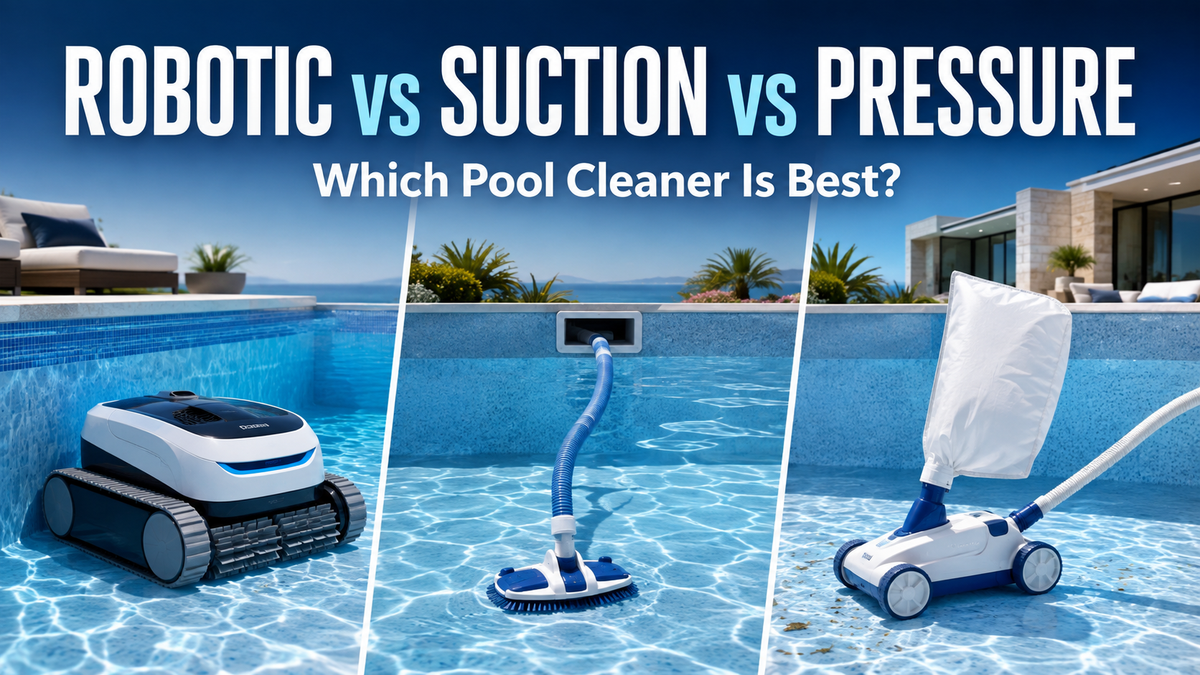
Robotic Pool Cleaner vs Suction Cleaner vs Pressure Cleaner: Which Is Best?
If you are shopping for an automatic pool cleaner, you will usually run into three main options: robotic pool cleaners, suction side cleaners, and pressure side cleaners.
All three are designed to reduce manual pool cleaning, but they do not work the same way.
A robotic pool cleaner is a self contained cleaner with its own motor and filtration system. A suction cleaner connects to your pool’s suction line or skimmer and uses your pool pump to move and vacuum debris. A pressure cleaner uses water pressure from your pool system or a booster pump to move around the pool and collect debris in a bag.
So which one is best?
For most modern pool owners, a robotic pool cleaner is usually the best overall choice because it offers the strongest combination of cleaning performance, convenience, filtration, wall cleaning, waterline cleaning, and independence from the pool pump.
That does not mean suction and pressure cleaners are useless. They can still make sense for certain pools, budgets, and existing pool equipment setups.
In this guide, TheRoboZone breaks down robotic pool cleaners vs suction cleaners vs pressure cleaners, how each type works, the pros and cons, and which option makes the most sense for your pool.

Quick Answer: Which Pool Cleaner Type Is Best?
For most residential pool owners, a robotic pool cleaner is the best overall option.
Robotic pool cleaners are usually more advanced, more independent, and more complete than suction or pressure cleaners. Many models can scrub the floor, climb walls, clean the waterline, filter debris internally, and operate without depending on the pool pump for movement.
A suction cleaner can be a good budget friendly option for simple pools with light debris.
A pressure cleaner can be a good option for pools that already have the right pressure line or booster pump setup and need better large debris collection than a basic suction cleaner.
But if you want the most complete cleaning experience with the least dependence on your pool’s plumbing system, robotic is usually the direction to compare first.
| Cleaner Type | Best For | Main Tradeoff |
|---|---|---|
| Robotic pool cleaner | Best overall cleaning, convenience, walls, waterline, and filtration | Higher upfront cost |
| Suction cleaner | Budget friendly cleaning for simple pools | Relies on pool pump and filtration system |
| Pressure cleaner | Large debris and pools with existing pressure cleaner setup | May require booster pump or dedicated pressure line |

What Is a Robotic Pool Cleaner?
A robotic pool cleaner is an automatic pool cleaning robot that operates independently from the main pool pump and filtration system.
Instead of using the pool’s suction line or pressure line, a robotic cleaner has its own internal motor, drive system, debris collection system, and filtration system.
Depending on the model, a robotic cleaner may clean the pool floor, walls, waterline, steps, surface, or a combination of these areas.
Some robotic pool cleaners are corded and connect to a power supply. Others are cordless and run on rechargeable batteries.
Robotic Pool Cleaner Advantages
- Strong overall cleaning performance
- Works independently from the pool pump
- Many models clean floors, walls, and waterlines
- Internal filter basket or cartridge captures debris
- Often better filtration than basic suction or pressure cleaners
- Can reduce strain on the pool’s main filtration system
- Many newer models include smart navigation, app control, or cleaning modes
- Cordless models remove the hassle of floating cables
Robotic Pool Cleaner Disadvantages
- Higher upfront cost than many suction cleaners
- Filters or baskets need to be emptied and cleaned
- Cordless models need charging
- Corded models require cable management
- Not every robotic cleaner handles every pool size, shape, or surface
Robotic cleaners are usually the most complete solution, but you still need to choose the right model for your pool.

What Is a Suction Side Pool Cleaner?
A suction side pool cleaner connects to your pool’s skimmer or dedicated suction port.
It uses suction from the pool pump to move around the pool and vacuum debris.
Because it depends on your pool’s circulation system, a suction cleaner sends debris toward the pool’s pump basket and filter system. Some setups may also use an inline leaf canister to catch larger debris before it reaches the pump basket.
Suction Cleaner Advantages
- Usually lower upfront cost
- Simple automatic cleaning option
- No separate power supply or battery charging
- Can work well for small or simple pools
- Good option for light dirt and fine debris when the pool system is properly set up
Suction Cleaner Disadvantages
- Relies on the pool pump
- Can add load to the pool filtration system
- May fill the pump basket or filter faster
- Usually less advanced than robotic cleaners
- May struggle with larger leaves and heavy debris unless supported by a leaf canister
- Coverage can depend heavily on pump flow and hose setup
- Many suction cleaners do not scrub walls or waterlines as effectively as premium robotic cleaners
Suction cleaners can still make sense, especially if your budget is limited and your pool has light debris. But they are usually not the best choice for homeowners who want the most complete, hands off cleaning experience.

What Is a Pressure Side Pool Cleaner?
A pressure side pool cleaner uses water pressure to move around the pool and collect debris.
Some pressure cleaners run off water returning from the pool system. Many pressure side cleaners require a dedicated pressure line and a booster pump for best performance.
Unlike many suction cleaners, pressure cleaners usually collect debris in a bag attached to the cleaner. That can help keep leaves and larger debris out of the main pool filter.
Pressure Cleaner Advantages
- Good for larger debris like leaves and small debris
- Debris bag can reduce load on the pool filter
- Can be reliable in pools already built for pressure side cleaners
- Often a familiar option for pool owners who already use Polaris style cleaners
- Can help circulate water while cleaning
Pressure Cleaner Disadvantages
- May require a booster pump
- May need a dedicated pressure line
- More plumbing dependent than robotic cleaners
- Debris bag still needs to be emptied
- Can be less efficient or less convenient than modern robotic cleaners
- May not scrub walls and waterlines as thoroughly as premium robotic cleaners
Pressure cleaners can make sense if your pool is already set up for one. If you are starting from scratch, it is worth comparing the total cost and convenience against a modern robotic pool cleaner.
Robotic vs Suction vs Pressure: Side by Side Comparison
| Category | Robotic Cleaner | Suction Cleaner | Pressure Cleaner |
|---|---|---|---|
| How it works | Self contained motor and filter system | Uses suction from the pool pump | Uses water pressure from pool system or booster pump |
| Pool pump dependence | Low | High | Medium to high |
| Debris collection | Internal basket or filter cartridge | Pool pump basket and filter system | Attached debris bag |
| Best debris type | Mixed debris, dirt, leaves, sand, waterline buildup | Light dirt and smaller debris | Larger leaves and debris |
| Wall cleaning | Many models can clean walls | Depends on model and setup | Depends on model and setup |
| Waterline cleaning | Available on many better models | Usually limited | Usually limited compared to premium robotics |
| Smart features | Often available | Usually limited | Usually limited |
| Upfront cost | Medium to high | Usually low to medium | Medium, plus pump or plumbing if needed |
| Best overall choice | Yes, for most modern pool owners | Best for budget and simple pools | Best for existing pressure setups and large debris |
Which Cleaner Does the Best Job?
For overall cleaning, robotic pool cleaners usually do the best job.
The reason is simple. A robotic cleaner is built as a dedicated cleaning machine. It does not depend on your pool pump to move. It can carry its own filters. It can scrub surfaces. Better models can climb walls, clean the waterline, and follow smarter cleaning paths.
Suction and pressure cleaners can still clean well, but they are more dependent on pool plumbing, flow, hoses, and setup.
If your goal is the cleanest pool with the least plumbing dependence, robotic is usually the winner.
Which Cleaner Is Best for Leaves?
For leaves, the answer depends on where the leaves are.
If leaves are floating on the surface, a robotic cleaner with surface cleaning or a robotic skimmer can help.
If leaves sink to the floor, a robotic cleaner with a good basket and strong debris pickup can work very well.
If the pool already has a pressure side cleaner setup, a pressure cleaner can also be good for leaves because it collects debris in a bag instead of sending it directly into the pool filter.
Suction cleaners can handle some leaves, but heavy leaf loads can fill the pump basket quickly or require an inline leaf canister.
If leaves are your main problem, read our full guide to the best robotic pool cleaners for leaves, dirt, and heavy debris.
Which Cleaner Is Best for Dirt and Sand?
For fine dirt, sand, pollen, and dust, filtration matters.
Robotic pool cleaners can be very strong here because many models use internal filters or cartridges designed to trap finer debris.
Suction cleaners can also remove fine debris, but that debris usually goes through the pool’s filtration system, which can mean more filter cleaning.
Pressure cleaners are often strong for larger debris, but fine debris performance depends on the cleaner and bag type.
If your pool gets sand, pollen, or fine dirt, look closely at filtration quality, not just suction power.
Which Cleaner Is Best for Walls and Waterlines?
Robotic pool cleaners are usually the best choice for walls and waterlines.
Many modern robotic cleaners are specifically designed to climb walls and scrub the waterline. This matters because grime, sunscreen, body oils, pollen, and debris often collect at the waterline.
Suction and pressure cleaners may climb walls depending on the model and pool setup, but they usually are not the strongest choice if waterline cleaning is a major priority.
If this matters to you, read our guide: Do robotic pool cleaners clean walls and waterlines?
Which Cleaner Is Easiest To Use?
For most homeowners, a robotic pool cleaner is the easiest to use.
With a cordless robotic cleaner, you charge the unit, place it in the pool, run the cleaning cycle, remove it, and clean the basket or filter.
With a corded robotic cleaner, you manage the cable and power supply, but the cleaner still works independently from the pool pump.
Suction and pressure cleaners can be easy once they are installed correctly, but they depend more on hoses, valves, pump flow, pressure, and plumbing configuration.
If you want the simplest modern ownership experience, robotic is usually the better fit.
Which Cleaner Is Cheapest?
Suction cleaners are usually the cheapest upfront option.
That is why they remain popular for simple pools and budget focused buyers.
Pressure cleaners often cost more than basic suction cleaners, especially if you need a booster pump or plumbing changes.
Robotic cleaners usually cost more upfront, but they can offer stronger cleaning performance, better filtration, and more convenience.
The cheapest option is not always the best value. A suction cleaner that saves money upfront may not be the best choice if your pool constantly has leaves, waterline grime, fine debris, or complex cleaning needs.
Which Cleaner Has the Lowest Long Term Cost?
Long term cost depends on the pool and the cleaner.
A suction cleaner may cost less upfront, but it relies on the pool pump and filter system. That can mean more pump runtime, more filter cleaning, and more dependence on the pool’s existing circulation system.
A pressure cleaner may need a booster pump and has its own wear parts and debris bag maintenance.
A robotic cleaner has a higher purchase price, but it is more independent from the pool system and can reduce the burden on the main filter.
For many homeowners, robotic cleaners offer the better long term value because they combine performance, independence, and convenience.
Which Cleaner Is Best for Inground Pools?
For inground pools, robotic cleaners are usually the best overall choice.
Inground pools often need better floor coverage, wall cleaning, waterline cleaning, larger debris capacity, and stronger navigation.
A good robotic cleaner can handle those needs better than most suction or pressure cleaners.
For more help choosing the right size, read What size robotic pool cleaner do I need for my pool?
When a Robotic Pool Cleaner Makes the Most Sense
A robotic pool cleaner is usually the best choice if:
- You want the best overall cleaning performance
- You want floor, wall, and waterline cleaning
- You want better filtration for dirt and sand
- You want less dependence on your pool pump
- You want cordless or app controlled convenience
- Your pool has leaves, dirt, sand, pollen, or mixed debris
- You want a modern hands off cleaning experience
If you want the strongest all around cleaner type, start with robotic.
When a Suction Cleaner Makes the Most Sense
A suction cleaner may make sense if:
- You want a lower upfront cost
- Your pool is simple
- Your debris load is light
- You already have good pump flow
- You do not need advanced wall or waterline cleaning
- You do not mind cleaning the pump basket or pool filter more often
Suction cleaners are not bad. They are just more basic and more dependent on the pool system.
When a Pressure Cleaner Makes the Most Sense
A pressure cleaner may make sense if:
- Your pool already has a pressure cleaner line
- You already have a booster pump setup
- You deal with larger leaves and debris
- You prefer a debris bag instead of sending debris into the main filter
- You are replacing an existing pressure side cleaner and want a familiar setup
Pressure cleaners can still be useful, especially in pools built around them. But if you are starting from scratch, compare the total cost against a robotic cleaner before committing.
Best Robotic Pool Cleaners To Compare
If you decide robotic is the best direction, the next step is choosing the right model.
Best Overall Robotic Option: Beatbot AquaSense 2 Pro
The Beatbot AquaSense 2 Pro is one of the strongest overall robotic pool cleaner options for homeowners who want a complete cordless system.
It is designed for floor, wall, waterline, surface cleaning, and water clarification, which makes it a strong fit for pool owners who want more than basic floor vacuuming.
Best Fit
- Residential inground pools
- Leaves and mixed debris
- Floor, wall, waterline, and surface cleaning
- Buyers who want cordless convenience
- Homeowners who want one of the most complete residential cleaner options
View Beatbot AquaSense 2 Pro at TheRoboZone
Best Premium AI Option: Beatbot AquaSense X AI
The Beatbot AquaSense X AI is the premium option for buyers who want advanced debris detection, smarter cleaning, and a flagship pool automation experience.
Best Fit
- Luxury pools
- Complex pool shapes
- Heavy debris variety
- Buyers who want the most advanced robotic cleaning option
View Beatbot AquaSense X AI at TheRoboZone
Best Value AI Option: WYBOT C2 Vision
The WYBOT C2 Vision is a strong value option for pool owners who want cordless robotic cleaning with AI vision support.
It is worth comparing if you want smart cleaning features without moving into the highest premium price range.
Best Fit
- Value focused buyers
- Residential pools
- Floor, wall, and waterline cleaning
- Buyers who want AI vision at a more accessible price point
View WYBOT C2 Vision at TheRoboZone
Best Corded Residential Option: BWT Advanced Pro 600
The BWT Advanced Pro 600 is a strong option for buyers who prefer corded power and consistent cleaning sessions without battery runtime concerns.
Best Fit
- Larger residential pools
- Buyers who prefer corded cleaning
- Fine dirt, sand, and filtration focused cleaning
- Pool owners who do not mind cable management
View BWT Advanced Pro 600 at TheRoboZone
Best Commercial Style Option: Maytronics Dolphin Wave 80
The Maytronics Dolphin Wave 80 is the better direction for large, shared, commercial style, or high demand pools.
Best Fit
- Large pools
- Commercial style pools
- Shared pool environments
- High demand cleaning needs
View Maytronics Dolphin Wave 80 at TheRoboZone
Common Mistakes To Avoid
Mistake 1: Buying Based Only on Price
The cheapest cleaner may work for a small, simple pool, but it may not be enough for leaves, sand, stairs, waterlines, or larger inground pools.
Mistake 2: Ignoring Your Pool Plumbing
Suction and pressure cleaners depend heavily on the pool’s plumbing, pump flow, and cleaner line setup. Do not assume they will work perfectly without checking your system.
Mistake 3: Expecting Every Cleaner To Clean the Waterline
Waterline cleaning is not automatic. If you want waterline scrubbing, choose a cleaner that specifically lists waterline cleaning.
Mistake 4: Ignoring Filter Maintenance
Every automatic cleaner needs maintenance. Robotic baskets, suction pump baskets, pool filters, and pressure cleaner bags all need to be cleaned.
Mistake 5: Choosing the Wrong Cleaner for Your Debris Type
Leaves, sand, pollen, dirt, bugs, and algae residue are different problems. Match the cleaner to the debris you actually deal with.

Final Verdict: Robotic Pool Cleaner vs Suction Cleaner vs Pressure Cleaner
For most pool owners, a robotic pool cleaner is the best choice.
Robotic cleaners offer the strongest combination of cleaning performance, filtration, wall cleaning, waterline cleaning, smart features, and independence from the pool pump.
Suction cleaners are best for budget focused buyers with simple pools and light debris.
Pressure cleaners are best for pools that already have the right pressure side setup and need large debris collection through a separate bag.
If you are buying a new automatic cleaner today and want the best overall experience, start by comparing robotic pool cleaners.
For most residential inground pools, the Beatbot AquaSense 2 Pro is one of the best places to start.
For premium AI cleaning, compare Beatbot AquaSense X AI.
For value focused cordless cleaning, compare WYBOT C2 Vision.
For corded residential power, compare BWT Advanced Pro 600.
For large or commercial style pools, compare Maytronics Dolphin Wave 80.
The best pool cleaner is not simply the most expensive one. It is the cleaner that fits your pool size, debris type, cleaning expectations, and maintenance routine.
FAQ
Is a robotic pool cleaner better than a suction cleaner?
For most pool owners, yes. Robotic pool cleaners are usually more advanced, more independent, and better at complete cleaning than suction cleaners. Suction cleaners can still make sense for simple pools and lower budgets.
Is a robotic pool cleaner better than a pressure cleaner?
Usually, yes for overall convenience and complete cleaning. Pressure cleaners can still be useful for large debris and pools already set up with a pressure side cleaner line or booster pump.
What is the cheapest type of automatic pool cleaner?
Suction side cleaners are usually the cheapest upfront. However, cheaper does not always mean better if your pool has heavy debris, waterline grime, or more complex cleaning needs.
Do robotic pool cleaners use the pool pump?
No. Robotic pool cleaners are self contained and operate independently from the pool’s main pump and filtration system.
Do suction cleaners use the pool pump?
Yes. Suction cleaners rely on suction from the pool pump and send debris through the pool’s pump basket and filtration system.
Do pressure cleaners need a booster pump?
Some do and some do not. Many pressure side cleaners require a dedicated booster pump for proper performance, so always check the exact model and pool setup.
Which pool cleaner is best for leaves?
Robotic cleaners with good debris capacity are strong for leaves, especially if leaves settle on the floor. Pressure cleaners can also be good for large debris if the pool already has the right setup.
Which pool cleaner is best for sand and dirt?
Robotic cleaners with strong filtration are usually the best choice for sand, dirt, pollen, and fine debris.
Which pool cleaner is best for waterline cleaning?
Robotic pool cleaners are usually the best choice for waterline cleaning, but only if the specific model is designed to clean the waterline.
Should I call before buying a pool cleaner?
Yes, especially if your pool has heavy debris, a deep end, an unusual shape, stairs, ledges, trees, fine dirt, or waterline buildup. TheRoboZone can help match the cleaner to your pool and cleaning needs.