
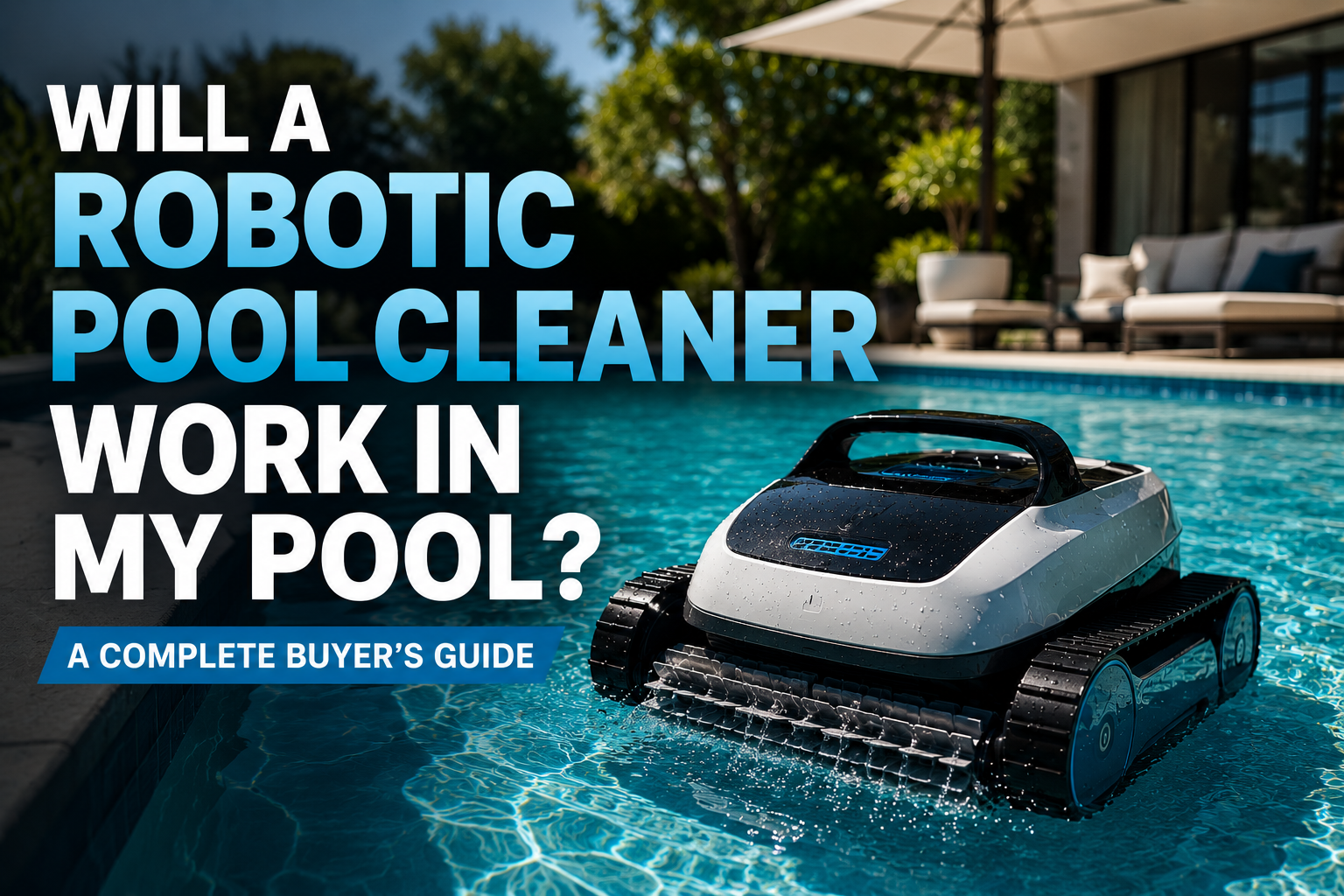
Will a Robotic Pool Cleaner Work in My Pool? A Complete Buyer’s Guide
One of the most common questions pool owners ask before buying a robotic pool cleaner is simple:
Will a robotic pool cleaner actually work in my pool?
For many pool owners, the answer is yes. A robotic pool cleaner can be one of the easiest ways to reduce manual cleaning, remove debris, scrub surfaces, and keep your pool looking better with less effort.
But not every robotic pool cleaner works well in every pool.
Your pool size, shape, surface, depth, debris level, steps, ledges, waterline buildup, and cleaning expectations all matter. A cleaner that works perfectly in one backyard pool may not be the right fit for a larger inground pool, a deep commercial style pool, or a pool with complex shallow areas.
In this guide, TheRoboZone explains how to tell whether a robotic pool cleaner will work in your pool, what features matter most, and how to choose the right model before you buy.

Quick Answer: Will a Robotic Pool Cleaner Work in My Pool?
A robotic pool cleaner will work in many pools if the cleaner is properly matched to the pool.
For the best results, the cleaner should match your:
- Pool size
- Pool type
- Pool surface
- Pool shape
- Debris level
- Cleaning areas needed
- Floor, wall, and waterline expectations
- Cordless or corded preference
If your pool is a standard residential inground pool, many modern robotic pool cleaners can work well. If your pool is large, heavily shaded, freeform, deep, commercial style, or has steps and shallow ledges, you need to be more selective.
The better question is not whether robotic pool cleaners work. The better question is which robotic pool cleaner works for your pool.
Robotic Pool Cleaner Compatibility Checklist
Before choosing a cleaner, review these key pool factors.
| Pool Factor | Why It Matters | What To Look For |
|---|---|---|
| Pool size | The cleaner must be rated for your pool length or bottom area | Choose a cleaner with enough coverage capacity |
| Pool type | Inground, above ground, and commercial pools may need different cleaners | Confirm the cleaner is rated for your pool type |
| Pool surface | Some cleaners perform differently on vinyl, fiberglass, tile, plaster, or concrete | Check surface compatibility before buying |
| Cleaning coverage | Some cleaners only clean the floor, while others clean walls and waterline | Look for floor, wall, and waterline cleaning if you want fuller coverage |
| Pool shape | Freeform, kidney, and L shaped pools can require stronger navigation | Choose a cleaner with smarter mapping or extra coverage capacity |
| Steps and ledges | Steps, benches, and sun shelves are harder for many cleaners | Confirm shallow area and step compatibility when needed |
| Debris level | Leaves, sand, pollen, and fine dirt require stronger filtration | Choose a cleaner with the right filter and debris capacity |

1. What Type of Pool Do You Have?
The first step is identifying your pool type.
Most robotic pool cleaners are designed for either residential pools or larger commercial style pools. Some are better for inground pools, some may work in above ground pools, and some are built for larger shared pools such as hotels, condos, clubs, schools, and community facilities.
Inground Pools
Most premium robotic pool cleaners are designed with inground pools in mind.
If you have an inground pool, you will usually want a cleaner that can handle the floor, walls, and waterline. This gives a more complete clean and reduces the amount of manual brushing needed.
Above Ground Pools
Some robotic pool cleaners can work in above ground pools, but you should always check the product specifications before buying.
Above ground pools may have different wall structures, pool liners, depths, and shapes. A cleaner that works well in an inground pool may not be the best fit for every above ground setup.
Commercial Style Pools
If you have a hotel pool, apartment pool, condo pool, school pool, club pool, or very large residential pool, you should look at larger pool or commercial style robotic cleaners.
These pools usually need stronger coverage, larger debris handling, better filtration, and heavier duty cleaning ability.
2. How Big Is Your Pool?
Pool size is one of the biggest factors in choosing a robotic pool cleaner.
Some cleaners are rated by maximum pool length, such as pools up to 33 feet, 40 feet, 50 feet, or 68 feet. Other cleaners are rated by pool bottom area, such as square feet of cleaning coverage.
Do not choose a cleaner that barely fits your pool on paper. If your pool is close to the cleaner’s maximum rating, it is usually better to step up to a stronger model.
Simple Pool Size Guide
| Pool Size | Best Cleaner Direction | Models To Compare |
|---|---|---|
| Small residential pool | Compact cordless or residential cleaner | Maytronics Dolphin Liberty 300, Mammotion Spino E1, Aiper Scuba N1 |
| Medium residential pool | Floor, wall, and waterline cleaner | Beatbot AquaSense 2, WYBOT C2 Vision, BWT Advanced Pro 150 |
| Large residential pool | Premium cordless or stronger corded cleaner | Beatbot AquaSense 2 Pro, Beatbot AquaSense 2 Ultra, BWT Advanced Pro 250, BWT Advanced Pro 600 |
| Large or commercial style pool | Larger pool or commercial style cleaner | Maytronics Dolphin Wave 80, Maytronics Dolphin Wave 100 |
| Complex pool with steps or shallow zones | Advanced cleaner with broader zone coverage | MOVA Rover X10 or similar advanced mapping cleaner |
If you are unsure what size cleaner you need, read our guide: What size robotic pool cleaner do I need for my pool?

3. Does Your Pool Need Floor, Wall, and Waterline Cleaning?
Not all robotic pool cleaners clean the same areas.
Some models clean only the pool floor. Others clean the floor and walls. More advanced models clean the floor, walls, and waterline. Some premium models can also help with surface debris and water clarity.
For most inground pool owners, floor, wall, and waterline cleaning is the better choice.
The waterline is where sunscreen, body oils, pollen, grime, and minerals often collect. If your cleaner only handles the floor, your pool may still look dirty around the tile line.
Cleaning Area Guide
| Cleaning Area | What It Means | Who Needs It |
|---|---|---|
| Floor | The cleaner removes dirt, leaves, and debris from the bottom | Every pool owner |
| Walls | The cleaner climbs and scrubs vertical surfaces | Most inground pool owners |
| Waterline | The cleaner scrubs the area where the water meets the wall | Pool owners with visible grime or tile line buildup |
| Surface | The cleaner or skimmer collects floating debris | Pools near trees, pollen, and leaves |
For more detail, read our full guide: Do robotic pool cleaners clean walls and waterlines?
4. What Shape Is Your Pool?
Pool shape can affect how well a robotic cleaner navigates.
A simple rectangular pool is usually easier for a robot to cover. Freeform, kidney, L shaped, and curved pools can require more advanced navigation or extra cleaning time.
Pool Shape Guide
| Pool Shape | Compatibility Notes | Best Direction |
|---|---|---|
| Rectangle | Usually easiest for robotic cleaners | Choose by size and cleaning coverage |
| Kidney or freeform | Curves can require smarter navigation | Choose a cleaner with extra coverage capacity |
| L shaped | May require better route planning | Choose stronger navigation and full pool coverage |
| Deep end pool | More wall surface and more cleaning demand | Choose strong wall climbing and waterline cleaning |
| Pool with shallow shelf | Not every cleaner handles shallow zones well | Confirm compatibility before buying |
If your pool shape is unusual, it is safer to choose a cleaner with stronger navigation and more coverage than the minimum required.
5. What Pool Surface Do You Have?
Pool surface matters because traction and scrubbing performance can vary.
Common pool surfaces include:
- Vinyl
- Fiberglass
- Concrete
- Gunite
- Tile
- Plaster
- Pebble finish
Before buying, confirm that the cleaner is compatible with your pool surface.
This is especially important for pools with delicate liners, unusual wall angles, textured surfaces, or slippery tile. If the cleaner cannot get proper traction, wall climbing and waterline cleaning may be less effective.

6. Will a Robotic Pool Cleaner Work With Steps, Benches, or Sun Shelves?
This is where many pool owners need to be careful.
A robotic pool cleaner may clean the floor, walls, and waterline well, but steps, benches, tanning ledges, and shallow shelves are more complicated.
Some cleaners may partially clean these areas. Some may avoid them. Some advanced models are designed with broader zone coverage for more complex pool layouts.
If steps and shelves are important to you, do not assume every cleaner will handle them. Check the specifications or contact TheRoboZone before buying.
Call Before Buying If Your Pool Has:
- Wide shallow tanning ledges
- Large built in benches
- Complex steps
- Very shallow areas
- Raised transitions
- Unusual corners or shelves
For complex pools, an advanced mapping cleaner like the MOVA Rover X10 may be worth comparing because it is designed for broader zone coverage beyond basic floor and wall cleaning.
7. How Much Debris Does Your Pool Get?
Debris level matters just as much as pool size.
A clean pool in an open backyard does not need the same cleaner as a pool surrounded by trees.
If your pool gets a lot of leaves, pollen, acorns, sand, dust, insects, or storm debris, choose a cleaner with stronger suction, better filtration, and a larger debris basket.
Choose a Stronger Cleaner If:
- Your pool sits near trees
- You get heavy leaves after storms
- You deal with sand or fine dirt
- Your pool needs frequent cleaning
- You want stronger filtration
- You want easier debris removal
For heavier debris pools, premium Beatbot models, BWT Advanced Pro models, WYBOT Vision models, and Maytronics Wave models are all worth comparing depending on the pool size and cleaning style you want.
8. Should You Choose Cordless or Corded?
Both cordless and corded robotic pool cleaners can work well, but they fit different buyers.
Cordless cleaners are popular because they are simple to use, easier to handle, and do not leave a cable across the pool deck.
Corded cleaners can be a strong choice for larger pools, longer cleaning sessions, and buyers who want consistent power without thinking about battery runtime.
Cordless May Be Better If:
- You want the cleanest setup
- You do not want a cable in the pool
- You want easy handling and storage
- Your pool size fits the cleaner’s runtime and coverage
- You prefer modern app based or smart cleaning features
Corded May Be Better If:
- You have a larger pool
- You want consistent power
- You do not want to manage battery runtime
- You want a proven traditional cleaning style
- You are comfortable managing the cord
For a deeper comparison, read our guide: Cordless vs corded robotic pool cleaners, which is better?
Best Robotic Pool Cleaner Direction by Pool Situation
The right model depends on your pool. Use this as a starting point.
| Your Pool Situation | Best Direction | Models To Compare |
|---|---|---|
| Small residential pool | Compact cordless or residential cleaner | Mammotion Spino E1, Aiper Scuba N1, Maytronics Dolphin Liberty 300 |
| Standard inground pool | Floor, wall, and waterline capable cleaner | Beatbot AquaSense 2, WYBOT C2 Vision, BWT Advanced Pro 150 |
| Large inground pool | Premium cordless or stronger corded cleaner | Beatbot AquaSense 2 Pro, Beatbot AquaSense 2 Ultra, BWT Advanced Pro 600 |
| Pool with heavy debris | Strong filtration and debris handling | BWT Advanced Pro models, WYBOT C2 Vision, Maytronics Wave models |
| Complex pool with shallow zones | Advanced mapping cleaner | MOVA Rover X10 |
| Commercial style pool | Commercial style robotic cleaner | Maytronics Dolphin Wave 80 or Wave 100 |
When a Robotic Pool Cleaner Is a Great Fit
A robotic pool cleaner is usually a great fit if:
- You want less manual vacuuming
- You want cleaner floors, walls, or waterlines
- Your pool size matches the cleaner’s rating
- Your pool surface is compatible
- You want easier weekly maintenance
- Your pool gets leaves, dirt, sand, or pollen
- You are willing to clean the filter basket after use
For most residential pool owners, the right robotic cleaner can make pool care much easier.
When a Robotic Pool Cleaner May Not Be the Best Fit
A robotic pool cleaner may not be the right solution if:
- Your pool is outside the cleaner’s size rating
- Your pool surface is not compatible
- Your pool has shallow ledges the cleaner cannot access
- Your pool has very unusual steps or tight areas
- You expect it to fully replace water chemistry maintenance
- You expect it to remove heavy algae without chemical treatment
- You do not want to clean the filter basket or charge the unit
A robotic pool cleaner is a maintenance tool. It can make the pool easier to keep clean, but it does not replace proper water chemistry, filter maintenance, or occasional manual attention in problem areas.
Common Mistakes To Avoid
Mistake 1: Buying Only by Price
The cheapest cleaner may not be the best fit for your pool. If it does not cover your pool size or cleaning needs, it may cost more frustration later.
Mistake 2: Ignoring Walls and Waterline
For many inground pools, floor only cleaning is not enough. If you want a cleaner looking pool, wall and waterline cleaning matter.
Mistake 3: Forgetting About Pool Shape
Freeform pools, steps, benches, and deep ends can require stronger navigation and coverage.
Mistake 4: Choosing a Cleaner That Barely Fits
If your pool is close to the cleaner’s maximum size rating, consider stepping up to a stronger model.
Mistake 5: Expecting It To Fix Water Chemistry
A robotic cleaner helps remove debris and scrub surfaces. It does not replace balancing chemicals, brushing severe algae, or maintaining your pool filtration system.

Final Verdict: Will a Robotic Pool Cleaner Work in Your Pool?
For many pool owners, yes, a robotic pool cleaner can work extremely well.
But the cleaner has to match the pool.
If your pool is small and simple, a compact residential cleaner may be enough.
If your pool is a standard inground pool, choose a model with floor, wall, and waterline cleaning.
If your pool is large, deep, freeform, or surrounded by trees, choose a stronger cleaner with more coverage, better filtration, and stronger navigation.
If your pool has steps, ledges, shallow shelves, or a commercial style layout, call TheRoboZone before buying so we can help you avoid choosing the wrong cleaner.
The best robotic pool cleaner is not simply the most expensive model. It is the cleaner that fits your pool size, shape, surface, debris level, and cleaning expectations.
FAQ
Will a robotic pool cleaner work in my pool?
In many cases, yes. A robotic pool cleaner can work well if it is properly matched to your pool size, type, surface, shape, and cleaning needs.
Do robotic pool cleaners work in inground pools?
Yes, many robotic pool cleaners are designed for inground pools. For inground pools, look for floor, wall, and waterline cleaning if you want fuller coverage.
Do robotic pool cleaners work in above ground pools?
Some robotic pool cleaners can work in above ground pools, but compatibility depends on the model, pool size, liner, wall structure, and cleaning coverage.
Will a robotic pool cleaner clean my pool walls?
Some robotic pool cleaners clean walls, but not all of them do. Check the cleaner’s listed coverage before buying.
Will a robotic pool cleaner clean my waterline?
Some robotic pool cleaners clean the waterline. If tile line grime is a concern, choose a model that specifically lists waterline cleaning.
Do robotic pool cleaners clean steps?
Some cleaners may clean certain steps or shallow areas, but many do not fully clean every step or ledge. Check compatibility before buying.
Can a robotic pool cleaner handle leaves?
Yes, many can handle leaves, but heavy debris pools should use a cleaner with strong suction, good filtration, and enough debris capacity.
Is cordless or corded better for my pool?
Cordless is often better for convenience and clean setup. Corded can be better for larger pools, longer cleaning sessions, and buyers who want consistent power.
What robotic pool cleaner should I buy if I am not sure?
Contact TheRoboZone before buying. Our team can help compare your pool size, shape, surface, debris level, and cleaning goals so you choose the right cleaner.