
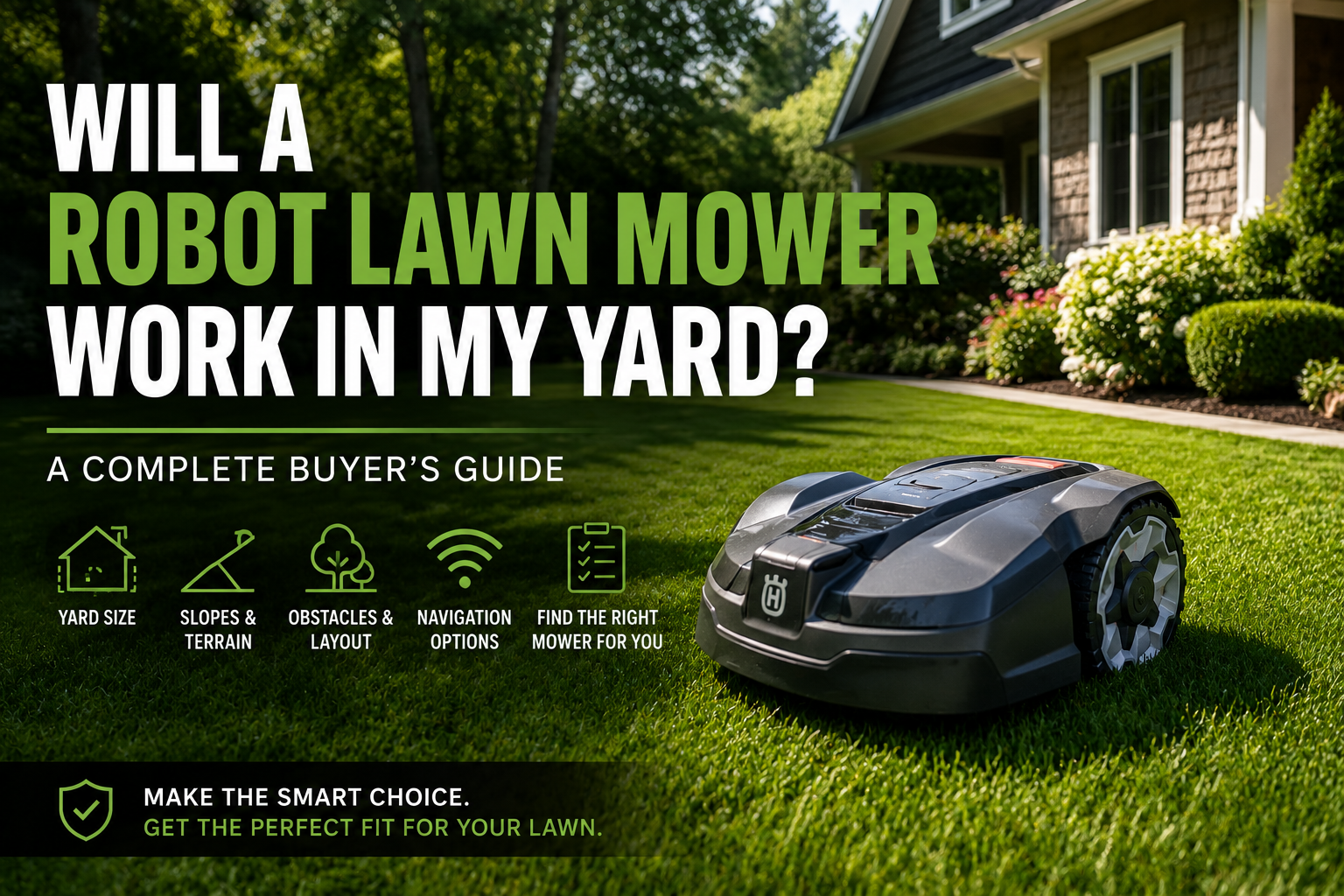
Will a Robot Lawn Mower Work in My Yard? A Complete Buyer’s Guide
One of the biggest questions homeowners ask before buying a robot lawn mower is simple:
Will a robot lawn mower actually work in my yard?
The answer is usually yes, but it depends on your lawn.
Robot lawn mowers have come a long way. Modern models can handle larger yards, slopes, multiple zones, complex layouts, wireless mapping, app control, obstacle detection, and regular automated mowing schedules. But not every robot mower is built for every property.
A small, flat suburban lawn is very different from a large yard with hills, trees, thick grass, drainage dips, narrow passages, fences, pets, and multiple mowing zones.
This guide will help you understand whether a robot lawn mower is right for your yard, what features matter most, and which mower style is the best fit for your property.

Quick Answer: Will a Robot Lawn Mower Work in My Yard?
A robot lawn mower will work in many yards if the mower is properly matched to the property.
For a robot mower to work well, your yard needs the right combination of lawn size, terrain, slope, grass condition, navigation setup, and mower capability.
If your lawn is flat, open, and regularly maintained, many robotic mowers can work.
If your yard has hills, uneven ground, thick grass, trees, multiple zones, or rough terrain, you need a more capable mower like the Lymow One Plus, Yarbo, Mowrator S1 4WD, or the right Husqvarna Automower iQ model.
The key is not asking whether robot mowers work. The better question is which robot mower works for your yard.

Robot Lawn Mower Yard Compatibility Checklist
Before choosing a mower, look at your yard through these seven questions.
| Yard Factor | Why It Matters | What To Look For |
|---|---|---|
| Lawn size | The mower must be sized for your total mowing area | Match the mower to your acreage, not just your lot size |
| Slope | Hills require traction and stability | Check the mower’s slope rating |
| Terrain | Ruts, roots, holes, and bumps can affect performance | Choose stronger traction for rough yards |
| Grass condition | Robot mowers are best for maintenance mowing | Cut overgrown grass down first |
| Obstacles | Toys, furniture, trees, and beds affect navigation | Look for obstacle detection and stay out zones |
| Multiple zones | Front, side, and back lawns may need separate mapping | Choose a mower with strong zone management |
| Navigation type | Some yards are better for wire, RTK, vision, or hybrid mapping | Match the navigation system to your property layout |
1. How Big Is Your Yard?
Lawn size is the first thing to check.
Do not choose a robot mower based only on the size of your full property. A one acre property may only have half an acre of actual mowable grass after subtracting the house, driveway, pool, patio, landscaping, woods, and garden beds.
What matters is your actual mowing area.
If your lawn is smaller and simpler, a compact or residential robotic mower may be enough. If your lawn is large, spread out, or broken into several zones, you should step up to a larger system.
General Lawn Size Guide
| Yard Size | Best Mower Direction | Models To Compare |
|---|---|---|
| Small residential lawn | Compact wireless or residential robot mower | TerraMow, Sunseeker, Husqvarna 410 iQ |
| Medium residential lawn | Stronger residential robot mower with mapping | Husqvarna 420 iQ, Sunseeker X7, Lymow One Plus |
| Large residential lawn | Premium robot mower with stronger coverage and terrain ability | Lymow One Plus, Husqvarna 440 iQ, Yarbo |
| Acreage or estate property | Large property robotic mowing system | Yarbo, Lymow One Plus |
| Rough, steep, or overgrown areas | Remote controlled heavy duty mower | Mowrator S1 4WD |
If you are not sure how much grass you actually mow, measure it with a property map, satellite view, or lawn measuring tool before buying.

2. Is Your Yard Flat, Sloped, or Hilly?
Slope is one of the most important factors when choosing a robot lawn mower.
A flat yard is easier. A sloped yard requires better traction, stronger drive power, and more stable turning. A very steep yard may need a mower built specifically for difficult terrain.
This is where many buyers make mistakes. A mower may be rated for your lawn size but still be the wrong choice if your yard has hills.
Best Options for Sloped Yards
| Yard Type | Best Direction | Recommended Model |
|---|---|---|
| Moderate residential slopes | Established residential robot mower | Husqvarna Automower iQ Series |
| Large sloped residential yard | Tracked autonomous mower | Lymow One Plus |
| Steep acreage or rough terrain | Tracked large property robot | Yarbo |
| Very difficult slopes or direct control areas | Remote controlled mower | Mowrator S1 4WD |
If your yard has hills, you should also read our guide to the best robot lawn mowers for hills, slopes, and uneven yards.
3. Is Your Yard Smooth or Uneven?
A robot mower can handle some uneven ground, but there is a difference between normal lawn texture and rough terrain.
Most robot mowers can deal with small bumps, gentle dips, and normal yard imperfections. They may struggle with deep holes, exposed tree roots, large ruts, washed out areas, loose soil, or sudden drops.
If your yard is rough, the drive system matters.
Traditional wheeled robotic mowers can be a good fit for cleaner residential lawns. Tracked mowers and all terrain platforms are better for difficult ground because they provide more contact with the lawn and better traction.
Signs Your Yard May Need a More Capable Robot Mower
- Your riding mower bounces heavily in certain areas
- You have tree roots close to the surface
- Your yard has drainage dips or washed out spots
- The grass is thick or patchy
- You have slopes combined with uneven ground
- Your lawn has soft soil after rain
- You have multiple zones with different terrain conditions
For these conditions, Lymow, Yarbo, and Mowrator are usually stronger starting points than a basic residential robot mower.

4. Does Your Yard Have Multiple Zones?
Many homeowners do not have one simple rectangle of grass.
Your property may include:
- Front yard
- Backyard
- Side yard
- Pool area
- Fence openings
- Driveway crossings
- Separate grass sections
- Garden beds and landscaping
Modern robot mowers can often handle multiple zones, but the details matter.
If the mower can physically travel between zones, mapping may be simple. If zones are separated by steps, gates, deep gravel, narrow passages, or disconnected sections, you may need a more advanced setup or manual transport between areas.
Questions To Ask
- Can the mower drive from one zone to another?
- Are there stairs or curbs between zones?
- Is there a gate that must stay open?
- Does the mower need to cross a driveway or path?
- Are the passages wide enough?
- Can each zone be mapped safely?
If your yard has multiple sections, choose a mower with strong mapping and zone control.
5. Do You Have Good Satellite Visibility?
Many wire free robotic mowers use RTK, GPS, EPOS, VSLAM, camera vision, or a combination of technologies to map and navigate your lawn.
These systems can work extremely well, but they need the right environment.
Open lawns with clear sky visibility are usually easier for satellite based systems. Heavy tree cover, tall buildings, narrow side yards, and covered areas can make navigation more complicated.
This does not mean a robot mower cannot work. It means you need the right navigation system.
Navigation Types Explained
| Navigation Type | Best For | What To Consider |
|---|---|---|
| Physical boundary wire | Properties where wire installation is acceptable | More setup work, but can be reliable in poor satellite areas |
| RTK or GPS | Open yards with strong sky visibility | May need careful antenna placement |
| Vision based navigation | Smaller lawns and yards with clear visual boundaries | Performance depends on lawn edges, lighting, and layout |
| Hybrid navigation | Complex yards with mixed conditions | Often a strong choice for real world properties |
For larger or more complex yards, hybrid systems like RTK plus vision based navigation can be especially valuable.

6. Is Your Grass Already Maintained?
Robot lawn mowers are best at maintaining grass, not rescuing neglected lawns.
If your grass is already very tall, thick, wet, or overgrown, you should mow it down with a traditional mower first. After that, a robot mower can maintain the lawn on a frequent schedule.
This is important because robot mowers typically take smaller, more frequent cuts. That is part of why they can keep lawns looking clean over time.
When To Prepare the Lawn First
- The grass is very tall
- The lawn has weeds above the cutting height
- There are sticks, toys, rocks, or debris in the yard
- There are holes or ruts that could trap the mower
- The lawn has heavy leaves or branches
- The ground is soft or muddy
If you start with a clean yard, the robot mower has a much better chance of performing well.
7. Do You Expect Perfect Edges?
A robot mower can dramatically reduce mowing work, but it may not fully replace trimming.
Edges near fences, walls, landscaping, pools, trees, curbs, and raised beds may still need occasional string trimming. This is normal.
The robot mower handles the repeated mowing. You may still handle the finishing touches.
If your goal is to eliminate most mowing time, a robot mower can be a great fit. If your goal is to never touch a trimmer again, your expectations should be realistic.
8. Do You Have Pets, Kids, or Objects in the Yard?
Robot mowers are designed with safety systems, but your yard still needs common sense setup.
Before mowing, keep the lawn clear of:
- Small toys
- Dog toys
- Garden hoses
- Loose branches
- Rocks
- Sports equipment
- Temporary decorations
Most robot mowers are built to detect obstacles, but small objects can still cause issues. A cleaner lawn means fewer interruptions and better mowing results.
If you have pets, it is smart to supervise early mowing sessions until you understand how your mower behaves around your yard.
Best Robot Mower by Yard Situation
The right robot mower depends on what your yard is actually like.
| Your Yard Situation | Best Direction | Models To Compare |
|---|---|---|
| Small clean residential lawn | Compact wireless mower | TerraMow V600 or V1000, Husqvarna 410 iQ |
| Medium residential lawn with app control | Residential wire free mower | Husqvarna 420 iQ, Sunseeker X7 |
| Large residential lawn with hills or complexity | Premium terrain focused robot mower | Lymow One Plus, Husqvarna 440 iQ |
| Large acreage or estate property | Large property robotic system | Yarbo |
| Rough, steep, or overgrown terrain | Remote controlled heavy duty mower | Mowrator S1 4WD |
| Not sure what your yard needs | Expert fit recommendation | Call TheRoboZone before buying |
When a Robot Lawn Mower Is a Great Fit
A robot mower is usually a great fit if:
- You want to reduce weekly mowing time
- You want your lawn maintained more consistently
- Your grass is already maintained or can be cut down first
- Your lawn has manageable slopes for the mower you choose
- Your yard can be mapped safely
- You are willing to do some setup and occasional maintenance
- You understand that trimming may still be needed
For many homeowners, the value is not just the cut. It is getting weekends back.
When a Robot Lawn Mower May Not Be the Best Fit
A robot mower may not be the best fit if your yard has major limitations that the mower cannot overcome.
Examples include:
- Disconnected lawn areas with no mower path
- Steep slopes beyond the mower’s rating
- Deep ruts, holes, or exposed roots
- Heavy brush instead of maintained lawn
- Very narrow passages
- Constant debris, toys, or pet waste in the yard
- Severe drainage issues
- No safe location for the charging station
Some of these issues can be fixed. Others may require a more specialized mower, a remote controlled mower, or a different mowing strategy.
How To Tell Which Robot Mower You Need
Use this simple decision guide.
Choose Husqvarna Automower iQ if:
- You want an established robotic mower brand
- Your lawn is residential and maintained
- You want a wire free setup with app control
- Your yard fits within the 410 iQ, 420 iQ, or 440 iQ coverage range
- Your slopes are moderate and inside the mower’s rating
View Husqvarna Automower 410 iQ
View Husqvarna Automower 420 iQ
View Husqvarna Automower 440 iQ
Choose Lymow One Plus if:
- Your lawn is large, sloped, or complex
- You want tracked traction
- Your yard has uneven ground or thicker grass
- You want wire free navigation
- You want a premium mower for tougher residential conditions
View Lymow One Plus at TheRoboZone
Choose Yarbo if:
- You have acreage or a large estate style property
- Your yard is too large for many standard robot mowers
- You want a rugged outdoor robot platform
- You want long term outdoor automation beyond basic mowing
- You need a serious system for large property maintenance
View Yarbo Robotic Lawn Mower at TheRoboZone
Choose Mowrator S1 4WD if:
- You want remote control instead of full autonomy
- Your yard has steep, rough, or difficult mowing sections
- You need more direct control
- You have tall grass, thick grass, or problem areas
- You want to mow from a safer distance
View Mowrator S1 4WD at TheRoboZone
Choose Sunseeker or TerraMow if:
- Your lawn is smaller to mid size
- You want a more compact wireless mowing setup
- You want vision based or hybrid navigation
- Your yard is cleaner and more residential
- You want a simpler robot mower option for everyday lawn maintenance
Compare all robot lawn mowers at TheRoboZone
Do Robot Lawn Mowers Work Under Trees?
They can, but tree coverage matters.
Heavy tree cover can affect satellite based navigation. Leaves, branches, roots, shade, and falling debris can also affect mowing performance.
If your yard has trees, look for a mower with strong obstacle detection, flexible mapping, and navigation that is appropriate for your property. Hybrid systems can be helpful because they are not relying on only one navigation method.
Can a Robot Lawn Mower Cross a Driveway or Path?
Some can, depending on the mower, setup, and surface.
A robot mower may be able to cross a flat driveway, sidewalk, or path if it is mapped correctly and the transition is safe. It may struggle with tall curbs, loose gravel, steps, deep gaps, or uneven transitions.
If crossing a driveway or path is required, confirm that the mower supports transport paths or zone connection features before buying.
Will a Robot Lawn Mower Work With a Fence?
Yes, but fences can create setup questions.
If the backyard is fenced, the mower needs a way to access the mowing area and return to the charging station. If the mower must pass through a gate, the gate usually needs to stay open during scheduled mowing.
If your front yard and backyard are separated by a fence, you may need separate zones, a transport path, manual carrying, or a specific setup plan.
Will a Robot Mower Handle Thick Grass?
Some robot mowers handle thicker grass better than others.
For thick or dense grass, pay attention to cutting power, blade design, cutting width, traction, and mowing frequency.
Even a strong robot mower performs best when it cuts regularly. If you let the grass get too tall, you may need to mow it down first before resuming automated maintenance.
What Should You Do Before Installing a Robot Mower?
Before installation, prepare your yard as much as possible.
- Cut the grass to a manageable height
- Pick up rocks, sticks, toys, and hoses
- Fill deep holes or ruts
- Trim low branches if needed
- Choose a safe charging station location
- Identify no go areas
- Decide which zones should be mowed
- Check slopes and transitions
- Make sure the mower can travel between zones safely
A little prep work can prevent a lot of frustration.

Final Verdict: Will a Robot Lawn Mower Work in Your Yard?
For many homeowners, yes, a robot lawn mower can work very well.
But the mower has to match the yard.
If your property is small, flat, and simple, a compact residential robot mower may be enough.
If your yard has hills, thick grass, uneven ground, or complex zones, choose a stronger model like Lymow, Yarbo, Husqvarna iQ, Sunseeker, or Mowrator depending on the situation.
If your yard is extremely rough, steep, or overgrown, a remote controlled option like Mowrator may be the safer and more practical choice.
The best robot lawn mower is not the one with the flashiest features. It is the one that fits your property, grass, slope, terrain, and expectations.
If you are not sure, contact TheRoboZone before buying. Our team can help compare your yard conditions and point you toward the mower that actually makes sense for your property.
FAQ
Will a robot lawn mower work in my yard?
In many cases, yes. A robot lawn mower can work well if the mower is properly matched to your lawn size, slope, terrain, grass condition, and layout.
Can robot lawn mowers handle hills?
Some can. Slope capability varies by model, so always compare the mower’s rating to the steepest part of your yard.
Can robot lawn mowers handle uneven ground?
Some robot mowers can handle mild uneven ground. Deep holes, ruts, roots, and rough terrain may require a more capable mower or yard prep before use.
Do robot lawn mowers work with multiple zones?
Many modern models support multiple mowing zones. The mower still needs a safe way to travel between zones or the zones may need to be managed separately.
Do robot lawn mowers need boundary wires?
Some do, but many newer models use wire free navigation with RTK, GPS, EPOS, vision, or hybrid mapping systems.
Will a robot lawn mower replace my mower completely?
For regular lawn maintenance, it can replace much of the mowing work. You may still need occasional trimming, cleanup, or manual mowing in problem areas.
Can a robot mower cut tall grass?
Some models can handle thicker grass better than others, but robot mowers are best for regular maintenance. If the grass is very tall, cut it down first.
What is the best robot lawn mower for a complicated yard?
For large, sloped, or uneven residential yards, Lymow One Plus is a strong option. For acreage, Yarbo is a strong option. For difficult terrain that needs direct control, Mowrator S1 4WD is worth comparing.
What is the best robot mower for a clean residential lawn?
For maintained residential lawns, Husqvarna Automower iQ models, Sunseeker, and TerraMow can all be worth comparing depending on lawn size and layout.
Should I call before buying a robot mower?
Yes, especially if your yard has hills, multiple zones, trees, fences, rough terrain, or unusual layout issues. TheRoboZone can help match the mower to your actual property.