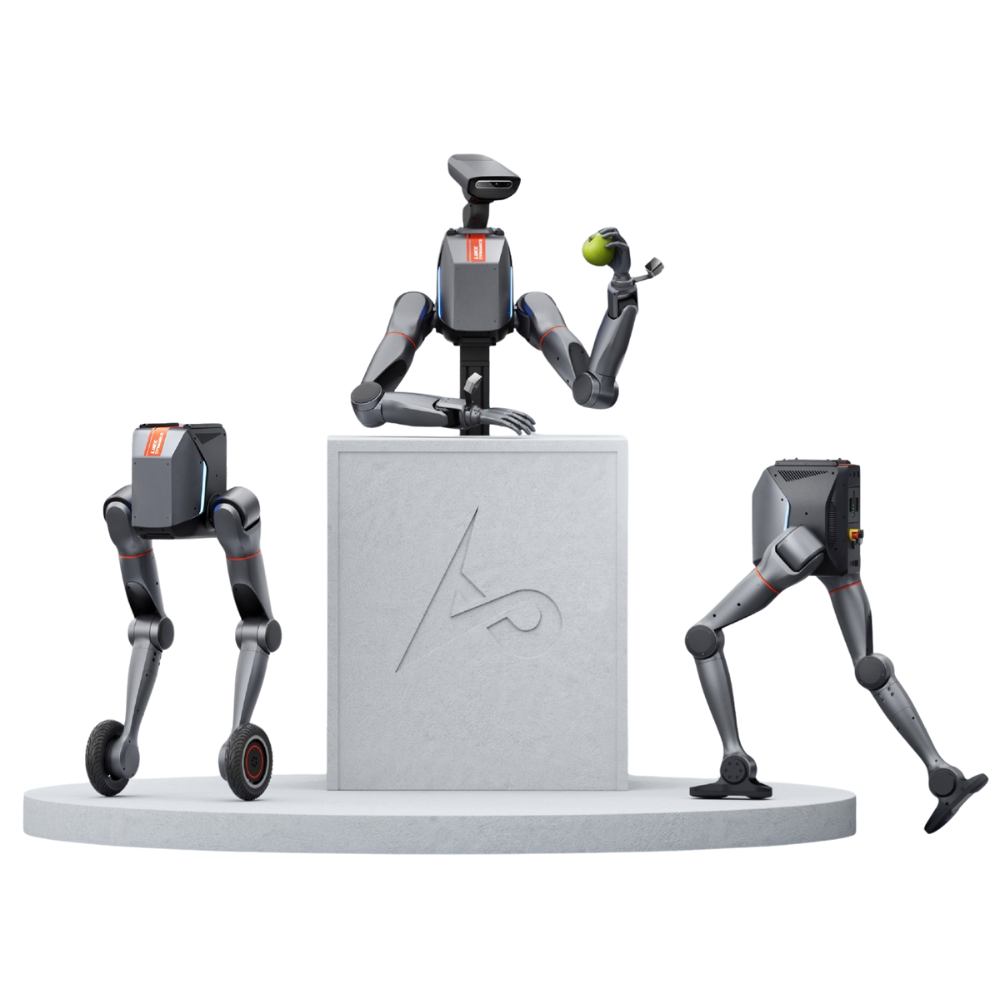
LimX Dynamics TRON 2 Multi-Form Embodied Robot
Dual arms. Bipedal legs. Wheeled mobility. One platform for all of it.
The TRON 2 is LimX Dynamics' most capable research platform — a tri-form embodied robot that combines 7-DoF dual arms, bipedal locomotion, and wheeled mobility in a single modular system configurable for manipulation research, mobile robotics, and VLA development. With a 30kg payload capacity, ±0.5mm repeat positioning accuracy, a native VLA data pipeline, and an AI computing box powered by an Intel i7 processor with 2TB storage, the TRON 2 is built for researchers and development teams ready to move beyond simulation and into real-world embodied AI deployment.
-
7-DoF arms with the largest workspace in its class. Each arm delivers a 70cm reach, 5kg end-effector load at maximum range, 5m/s maximum speed, and 20N gripping force — with a spherical human-like wrist for agile wide-range operation. Dual redundant power design keeps arms locked in position even during power loss, and active safety boundary protection prevents collision damage during teleoperation.
-
Tri-form mobility — reconfigure for any mission. Sole bipedal mode handles stairs and dynamic environments at up to 3m/s with 20cm step clearance; wheeled mode reaches 5m/s on flat terrain with a 30kg payload and auto-recharging capability. Switch between configurations to match the research task without changing platforms.
-
Native VLA pipeline from data to deployment. An integrated all-in-one data acquisition and management system covers collection, cleaning, annotation, training, inference, and task management in a single workflow. Preloaded with standard algorithm tasks including ACT and Pi0.5, with 20+ example tutorials and open-sourced real-world datasets — designed to get researchers from unboxing to running experiments in under 2 hours.
-
Fully open, Python and ROS native. Complete SDK access, full high and low-level hardware interface, ROS1/ROS2 compatibility, clear URDF for optimised Sim2Real performance, and support for NVIDIA Isaac Sim, MuJoCo, and Gazebo — with ongoing updates via GitHub.
Specifications
| Category |
Details |
| Configurations |
Dual Arms / Sole (Bipedal) / Wheeled — tri-form modular |
| Material |
Aluminium alloy + plastic |
| Degrees of Freedom — Single Arm |
7 DoF |
| Degrees of Freedom — Single Leg |
5 DoF |
| Degrees of Freedom — Active Vision Head |
2 DoF |
| Max End-Effector Load |
5kg (max) / 3kg (extended reach) per arm |
| Max End-Effector Speed |
5 m/s |
| Max End-Effector Acceleration |
36 m/s² |
| Repeat Positioning Accuracy |
±0.5 mm |
| Teleoperation Delay |
100 ms |
| Teleoperation Method |
VR — Oculus Quest 3 |
| End Effector Options |
Gripper / Dexterous hand |
| Gripper Force / Width |
20N max / 85mm |
| Max Speed — Sole |
2–3 m/s |
| Max Speed — Wheeled |
3–5 m/s |
| Max Climbing Slope — Sole |
15° |
| Max Climbing Slope — Wheeled |
30° |
| Max Step Height |
20 cm |
| Max Load — Flat Ground |
30 kg |
| Max Load — Stair Climbing |
20 kg |
| Battery Voltage |
46.8V |
| Battery Capacity |
9 Ah |
| Maximum Battery Power |
2,800W |
| Battery Type |
Ternary lithium — swappable |
| Charging Time (20–80%) |
30 minutes |
| Charging Time (20–100%) |
54 minutes |
| Charging Power |
542W |
| AI Computing CPU |
11th Gen Intel Core i7-1165G7 @ 2.80GHz |
| Storage |
2TB |
| Sensors — Standard |
IMU + Waist RGBD Camera |
| Sensors — Dual-Arms Config |
Head RGBD Camera + Wrist RGBD Camera |
| Communication Ports |
Ethernet ×1, USB 3.0 ×1, EtherCAT ×2, RS485 ×1 |
| AI Box Interfaces |
4× ETH, 4× USB 3.0, 1× 24V input, 1× 12V output |
| Power Output Ports |
12V / 24V / 48V — 1 port each |
| Software |
Python, C++, ROS1/ROS2 |
| Simulation Platforms |
NVIDIA Isaac Sim, MuJoCo, Gazebo |
| SDK |
Fully open — high and low level access |
| Editions |
EDU / Standard |