
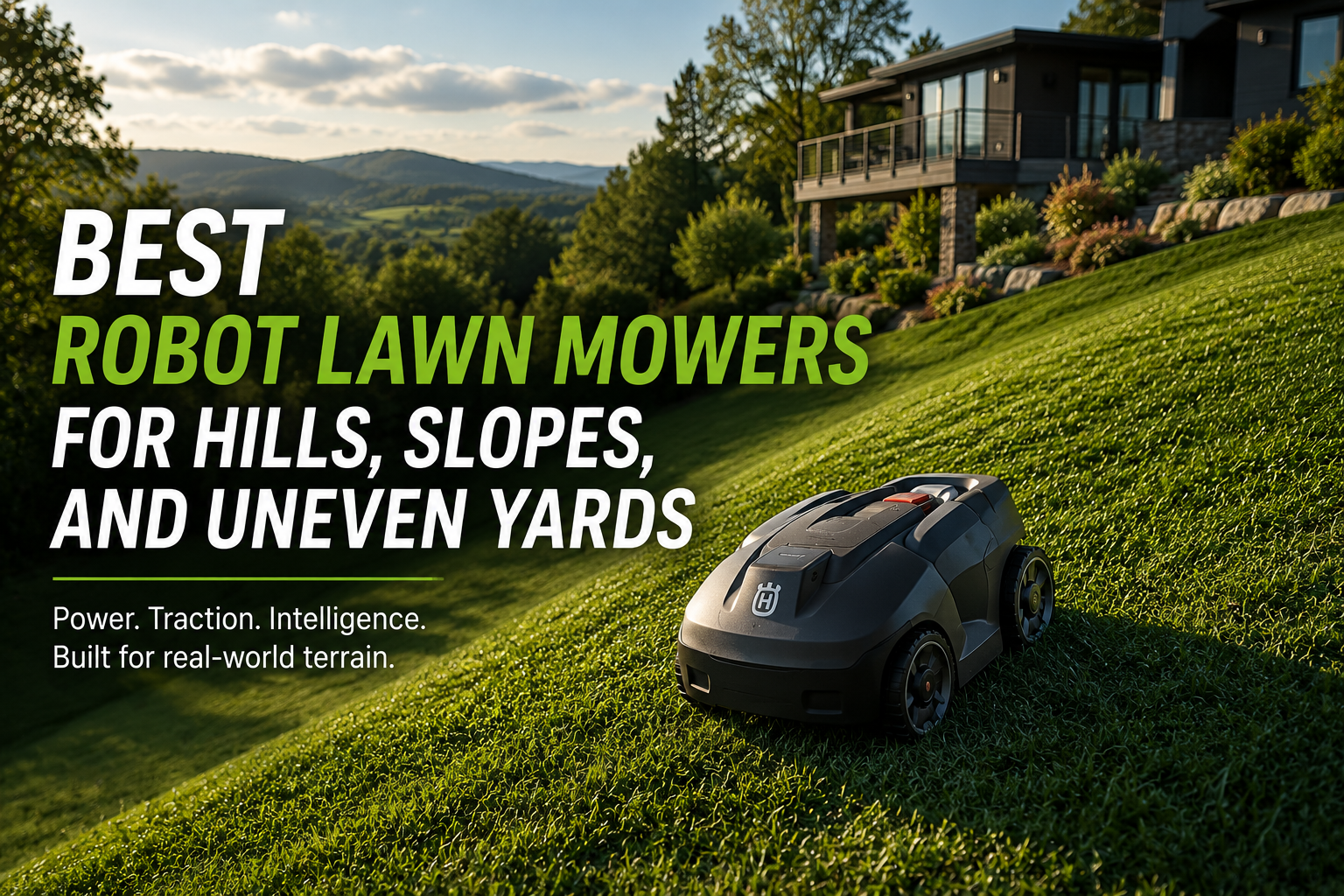
Best Robot Lawn Mowers for Hills, Slopes, and Uneven Yards
Not every lawn is flat, smooth, and easy to mow.
Some yards have hills. Some have slopes behind the house. Some have drainage dips, uneven ground, tree roots, rough patches, thick grass, or areas that bounce a riding mower around more than expected.
That is where choosing the right robotic lawn mower becomes more important.
A basic robot mower may work well on a small, flat suburban lawn, but hills and uneven terrain require more traction, better stability, smarter navigation, stronger cutting performance, and a mower that is actually designed for difficult real-world conditions.
In this guide, TheRoboZone breaks down the best robot lawn mowers for hills, slopes, and uneven yards, what slope ratings actually mean, and how to choose the right mower for your property.

Quick Answer: What Is the Best Robot Lawn Mower for Hills?
For most large residential yards with hills, slopes, and uneven terrain, the Lymow One Plus is our top pick because it uses a tracked drive system, wire-free navigation, and a heavy-duty cutting design built for more demanding lawn conditions.
For very large sloped properties, acreage, and rough terrain, Yarbo is one of the strongest options because it is designed for all-terrain outdoor use and handles steep slopes with a rugged tracked platform.
For customers who want direct control on steep slopes, rough areas, overgrowth, or difficult mowing zones, the Mowrator S1 4WD is a strong remote-controlled option.
For homeowners who want an established robotic mower brand for moderate residential slopes, Husqvarna is now a serious option to compare.
Best Robot Lawn Mowers for Hills and Uneven Yards: Our Top Picks
| Model | Best For | Why It Stands Out |
|---|---|---|
| Lymow One Plus | Best overall for hills and uneven residential yards | Tracked drive, wire-free navigation, strong cutting system, and premium terrain capability |
| Yarbo Robotic Lawn Mower | Best for acreage, steep slopes, and rough ground | All-terrain tracked platform designed for larger properties and difficult conditions |
| Mowrator S1 4WD | Best remote-controlled mower for steep or difficult terrain | Direct control, four-wheel drive, wide cutting deck, and strong slope capability |
| Husqvarna Automower iQ Series | Best established-brand option for moderate residential slopes | 410 iQ, 420 iQ, and 440 iQ options for 0.5 to 2 acre lawns with up to 45% slope capability inside the mowing area |
Why Hills and Slopes Are Harder for Robot Lawn Mowers
Sloped yards create challenges that flat lawns do not.
When a robot mower climbs a hill, it needs traction. When it turns on a slope, it needs stability. When the grass is wet, thick, or uneven, it needs enough grip to avoid slipping, spinning, or getting stuck.
That is why slope rating matters, but it is not the only thing that matters.
A mower can have a strong slope rating on paper and still struggle if the lawn is full of holes, soft soil, exposed roots, narrow passages, wet grass, or sharp transitions.
For hills and uneven yards, you should look at:
- Slope rating
- Drive system
- Wheel or track design
- Cutting deck design
- Obstacle handling
- Navigation system
- Weight distribution
- Whether the mower is autonomous or remote-controlled
- Whether the mower is properly sized for the property

Slope Ratings Explained: Percent Grade vs Degrees
One of the most confusing parts of buying a robot mower for hills is understanding slope ratings.
Some brands describe slope as a percentage. Others use degrees. They are not the same thing.
A 45% slope is not the same as a 45-degree slope. A 45-degree slope is much steeper. In fact, a 45-degree slope is equal to a 100% grade.
That matters because misreading slope ratings can lead to buying the wrong mower.
| Slope Grade | Approximate Degrees | What It Means |
|---|---|---|
| 25% | About 14° | Mild to moderate slope |
| 45% | About 24° | Steeper residential slope |
| 70% | About 35° | Very steep slope |
| 75% | About 37° | Extremely steep mowing condition |
| 100% | 45° | Severe slope; not suitable for many robotic mowers |
Before buying, try to estimate the steepest part of your yard. If you are close to the mower’s maximum rating, it is usually smarter to choose a more capable machine.
What To Look For in a Robot Mower for Hills
1. Strong Traction
Traction is the most important feature for hills.
Wheeled mowers can work well on moderate slopes, but tracked systems often provide better grip on uneven or soft ground because they spread the mower’s weight across more surface area.
This is one reason Lymow and Yarbo are so strong for difficult terrain. Their tracked designs are built for more than simple flat lawns.
2. Stability When Turning
Climbing a slope is one thing. Turning on a slope is another.
A mower that loses traction while turning may slide, leave marks, get stuck, or fail to complete the area. For yards with side slopes, curved hills, or tight transitions, stability matters just as much as climbing ability.
3. Proper Cutting Height
Uneven yards often need a higher cutting height.
If the mower is set too low, it may scalp high spots or struggle over rough terrain. A mower with flexible cutting height settings gives you more control over cut quality.
4. Smart Navigation
Hilly yards are often more complex than flat yards.
They may include retaining walls, tree lines, narrow passages, garden beds, patios, slopes near driveways, or separate mowing zones. Wire-free navigation can make setup easier and help manage complex properties more cleanly.
5. Enough Mower for the Job
Do not buy the smallest mower that technically matches your lawn size.
Slopes, thick grass, rough ground, and multi-zone layouts all make the mower work harder. If your yard is difficult, step up to a more capable model.

Best Overall for Hills and Uneven Residential Yards: Lymow One Plus
The Lymow One Plus is our top overall recommendation for many homeowners with hills, slopes, and uneven yards.
The reason is simple: Lymow is designed for the type of terrain that gives basic robotic mowers trouble.
Its tracked drive system gives it a major advantage over traditional small-wheeled robot mowers. Tracks can help the mower maintain traction on slopes, uneven ground, and more demanding lawn surfaces.
Lymow also uses wire-free RTK plus VSLAM navigation, which is important for properties where installing boundary wire around complex hills or uneven zones would be frustrating.
Why Lymow One Plus Stands Out
- Tracked drive system for stronger terrain confidence
- Designed for hills, slopes, and uneven ground
- Wire-free RTK plus VSLAM navigation
- Dual rotary blade cutting system
- Strong fit for large and complex residential lawns
- Premium positioning for buyers who want more than a basic robot mower
Best Fit
Lymow One Plus is best for:
- Large residential lawns
- Sloped yards
- Uneven terrain
- Dense grass
- Multi-zone properties
- Homeowners who want wire-free mowing
- Buyers who want a premium robotic mower for difficult lawn conditions
What To Consider
Lymow One Plus is built for serious residential mowing, but it is still best used as a maintenance mower.
If your grass is extremely overgrown, mow it down first before letting the robotic mower maintain it on schedule. This is true for almost every robotic mower. Robot mowers perform best when they are maintaining grass regularly, not rescuing an overgrown field.
View Lymow One Plus at TheRoboZone

Best for Acreage, Steep Slopes, and Rough Ground: Yarbo Robotic Lawn Mower
The Yarbo Robotic Lawn Mower is one of the best options for large properties with steep slopes, rough ground, and acreage.
Yarbo is built more like an outdoor robot platform than a small residential gadget. Its tracked design helps it handle terrain that would challenge many standard robotic mowers.
For buyers with large lawns, estate properties, and rough outdoor conditions, Yarbo should be one of the first models to compare.
Why Yarbo Stands Out
- Designed for large properties and acreage
- Tracked all-terrain platform
- Strong slope capability
- Wire-free operation
- Better suited to rough ground than many smaller robotic mowers
- Part of a modular outdoor robot platform
Best Fit
Yarbo is best for:
- Very large yards
- Estate properties
- Multi-acre lawns
- Steep slopes
- Rough ground
- Property owners who want a rugged outdoor robot
- Buyers considering long-term outdoor automation
What To Consider
Yarbo may be more machine than a smaller residential yard needs.
If your yard is large, sloped, and complex, Yarbo can make a lot of sense. If your lawn is under one acre and mostly residential with a few hills, Lymow may be the better starting point.
View Yarbo Robotic Lawn Mower at TheRoboZone

Best Remote-Controlled Option for Steep Slopes: Mowrator S1 4WD
The Mowrator S1 4WD is different from Lymow and Yarbo.
It is not a fully autonomous robotic mower. It is a remote-controlled mower.
That distinction matters. If you want the mower to operate on a schedule with minimal involvement, start with Lymow or Yarbo. If you want to control a powerful mower from a safer distance on steep, rough, or overgrown areas, Mowrator becomes very interesting.
Why Mowrator S1 4WD Stands Out
- Remote-controlled mowing
- Four-wheel drive
- Strong slope capability
- Wide cutting deck
- Useful for rough, steep, or difficult mowing zones
- Good option for users who want control instead of full autonomy
Best Fit
Mowrator S1 4WD is best for:
- Steep slopes
- Rough terrain
- Tall grass
- Difficult mowing zones
- Drainage areas
- Large properties with problem sections
- Users who prefer direct remote control
What To Consider
Mowrator is not the best choice if you want a fully hands-free mowing schedule.
It is better for property owners who want more power and control on difficult terrain. For some yards, the best setup may even be a fully autonomous mower for regular lawn maintenance plus Mowrator for the roughest sections.
View Mowrator S1 4WD at TheRoboZone

Best Established Brand Option for Moderate Slopes: Husqvarna Automower iQ Series
Husqvarna is one of the most established names in robotic mowing.
For homeowners who want an established robotic mower brand with wire-free installation, app control, virtual mapping, and strong residential support, the Husqvarna Automower iQ Series is worth comparing.
The 410 iQ, 420 iQ, and 440 iQ are designed for American residential lawns and can handle slopes up to 45% inside the mowing area. They also have mowers that support both virtual wire and physical wire installation, giving homeowners flexibility depending on their property layout.
However, they should be positioned correctly. These are strong residential robotic mowers for moderate slopes, clean lawns, and homeowners who want a proven brand. For extreme slopes, rough terrain, tracked traction, or more difficult ground conditions, Lymow, Yarbo, or Mowrator may still be the stronger fit.
Husqvarna Automower iQ Model Comparison
| Model | Best For | Lawn Size | Slope Capability | Installation Type |
|---|---|---|---|---|
| Husqvarna Automower 410 iQ | Smaller residential lawns with moderate slopes | Up to 0.5 acre | Up to 45% inside installation area | Virtual wire |
| Husqvarna Automower 420 iQ | Mid-size residential lawns | Up to 1 acre | Up to 45% inside installation area | Virtual wire |
| Husqvarna Automower 440 iQ | Larger residential lawns and estate-style properties | Up to 2 acres | Up to 45% inside installation area | Virtual wire |
Why Husqvarna Automower iQ Stands Out
- Established robotic mower brand
- Wire-free installation with virtual mapping
- Automower Connect app control
- Supports custom mowing areas and stay-out zones
- Wide 1 to 4 inch cutting height range
- Good fit for residential lawns with moderate slopes
- Available in 0.5 acre, 1 acre, and 2 acre options
Best Fit
Husqvarna Automower iQ models are best for:
- Residential homeowners who want an established brand
- Moderate slopes up to 45% inside the mowing area
- Clean, maintained lawns
- Buyers who want app-based control and virtual mapping
- Customers choosing between 0.5 acre, 1 acre, and 2 acre lawn capacities
- Homeowners who prefer a traditional robotic mower platform over a tracked mower
What To Consider
The Husqvarna Automower iQ Series is a strong residential option, but slope rating should be read carefully.
The 45% slope rating applies inside the installation area. The maximum slope performance at the boundary is lower. This matters if the steepest part of the yard is near a driveway, fence, road, wall, pond, or landscaping edge.
If the customer’s yard has severe slopes, rough ground, deep ruts, thick grass, or uneven terrain, a tracked mower like Lymow or Yarbo may still be the better recommendation.
View the Automower iQ Mowers here.
Best Robot Mower by Yard Type
| Yard Type | Best Direction | Recommended Model |
|---|---|---|
| Large residential yard with hills | Tracked autonomous mower | Lymow One Plus |
| Uneven residential lawn with dense grass | Premium terrain-focused robot mower | Lymow One Plus |
| Multi-acre sloped property | Large all-terrain robot mower | Yarbo |
| Extremely steep or rough problem areas | Remote-controlled mower | Mowrator S1 4WD |
| Moderate residential slopes with established brand preference | Husqvarna Automower iQ comparison | Husqvarna 410 iQ, 420 iQ, or 440 iQ |
Can Robot Lawn Mowers Handle Uneven Ground?
Some can. Some cannot.
Uneven ground is different from a simple hill. A mower may climb a slope well but still struggle with holes, roots, ruts, soft soil, transitions, or rough patches.
If your yard is bumpy, look for:
- Strong traction
- A stable drive system
- Good obstacle handling
- A cutting deck that can handle terrain changes
- Enough ground clearance
- A mower that is not undersized for the property
For uneven yards, Lymow and Yarbo are especially strong comparisons because both use tracked designs. Mowrator is also worth considering when the terrain is too rough for fully autonomous mowing.
Can Robot Lawn Mowers Work on Wet Slopes?
Wet slopes are more difficult than dry slopes.
Even a capable mower can lose traction if the grass is wet, the soil is soft, or the slope is steep. Wet mowing can also create ruts, wheel marks, or sliding in certain conditions.
For hilly properties, it is smart to adjust the mowing schedule around weather. If a steep section gets slippery after rain, avoid forcing the mower to handle that section immediately after a storm.
Do You Need a Special Robot Mower for Hills?
If your yard has mild slopes, not always.
If your yard has steep slopes, uneven ground, thick grass, or problem areas, yes, you should choose a mower designed for terrain handling.
For hills, the drive system matters more than it does on flat lawns. A mower with better traction, more stable movement, and stronger terrain capability can make the difference between a clean automated lawn and constant stuck alerts.
Common Mistakes To Avoid When Buying a Robot Mower for Hills
Mistake 1: Confusing Percent Grade With Degrees
This is one of the biggest mistakes shoppers make.
A 45% slope is not the same as a 45-degree slope. Always confirm the rating format before choosing a mower.
Mistake 2: Buying Based Only on Lawn Size
A mower may match your acreage but still be wrong for your terrain.
For hilly yards, slope rating, traction, and drive system are just as important as coverage.
Mistake 3: Ignoring the Boundary Area
Some mowers can handle steeper slopes inside the mowing area than they can near boundaries.
If your steepest slope is close to a fence, driveway, wall, road, pond, or garden bed, be extra careful with model selection and setup.
Mistake 4: Expecting a Robot Mower To Fix Rough Land
A robotic mower can maintain grass, but it cannot fix holes, ruts, exposed roots, or poor grading.
If your yard is extremely rough, some prep work may be needed before automation works reliably.
Mistake 5: Choosing a Lightweight Mower for Heavy Terrain
Small lightweight mowers can be great for flat lawns, but hills and rough ground demand more traction and stability.
For challenging terrain, step up to a mower built for the job.

Final Verdict: Best Robot Lawn Mower for Hills and Uneven Yards
For most large residential yards with hills, slopes, and uneven terrain, the best overall choice is the Lymow One Plus.
It offers the right mix of tracked traction, wire-free navigation, cutting performance, and premium terrain capability for homeowners who want serious robotic mowing.
For acreage, steep slopes, and rough ground, choose Yarbo.
For the steepest or most difficult areas where you want direct control, choose Mowrator S1 4WD.
For moderate residential slopes and customers who prefer an established robotic mower brand, compare the Husqvarna Automower 410 iQ, Husqvarna Automower 420 iQ, and Husqvarna Automower 440 iQ.
The best mower for hills is not just the one with the highest number on a spec sheet. It is the mower that matches your slope, terrain, lawn size, grass conditions, and level of automation you actually want.
FAQ
What is the best robot lawn mower for hills?
For many large residential yards with hills and uneven terrain, Lymow One Plus is our top pick because it uses a tracked drive system, wire-free navigation, and a terrain-focused design.
Can robot lawn mowers handle steep slopes?
Some robot lawn mowers can handle steep slopes, but capability varies by model. Always check the slope rating and make sure you understand whether the rating is listed in percent grade or degrees.
What is the difference between percent slope and degrees?
Percent grade and degrees measure slope differently. A 45% slope is about 24 degrees, while a 45-degree slope is a 100% grade. This difference matters when comparing robot mower specs.
Are tracked robot mowers better for hills?
Tracked robot mowers can be better for hills and uneven terrain because tracks spread weight over more surface area and can provide stronger traction than small wheels.
Can robot lawn mowers handle bumpy yards?
Some can, but it depends on how rough the yard is. Mild uneven ground may be fine for a capable mower, while deep holes, ruts, exposed roots, and soft soil may need yard prep first.
Is Mowrator fully autonomous?
No. Mowrator S1 4WD is a remote-controlled mower, not a fully autonomous robot mower. It is best for users who want direct control on steep, rough, or difficult terrain.
Is Husqvarna good for hills?
Husqvarna can be good for moderate residential slopes when the model matches the lawn. The Husqvarna Automower 410 iQ, 420 iQ, and 440 iQ are listed for up to 45% slope capability inside the mowing area.
Which Husqvarna Automower iQ model should I choose?
Choose the Husqvarna Automower 410 iQ for lawns up to 0.5 acre, the 420 iQ for lawns up to 1 acre, and the 440 iQ for lawns up to 2 acres. For very rough or extreme terrain, compare Lymow, Yarbo, or Mowrator as well.
Should I buy more mower than I need for a hilly yard?
Usually, yes. Hills, rough ground, and thick grass make a mower work harder. If your yard is difficult, buying a more capable model can improve long-term satisfaction.