
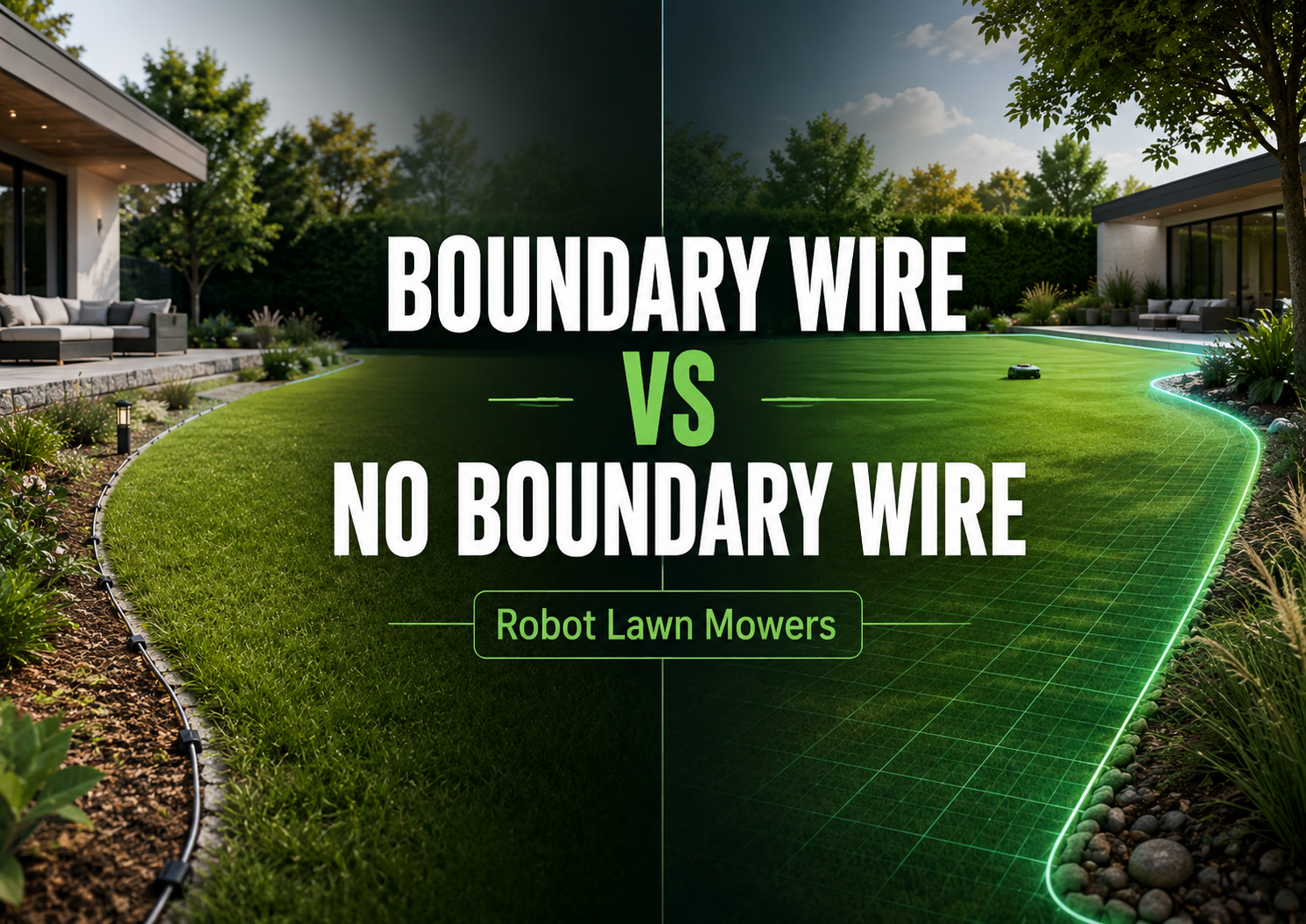
Robot Lawn Mowers: Boundary Wire vs No Boundary Wire
One of the biggest decisions when buying a robot lawn mower is whether to choose a model with a boundary wire or a wire free mower with no boundary wire.
Both styles can work. The better choice depends on your yard, your budget, your patience for installation, your tree coverage, your mowing zones, and how much flexibility you want after setup.
Traditional robotic mowers use a physical boundary wire to tell the mower where to cut. Newer wire free robot mowers use technology like RTK, GPS, EPOS, VSLAM, AI vision, LiDAR, cameras, and onboard sensors to create virtual boundaries instead.
If you are comparing boundary wire vs no boundary wire robot lawn mowers, this guide will help you understand the difference, the pros and cons, and which type makes the most sense for your property.

Quick Answer: Boundary Wire vs No Boundary Wire Robot Mowers
A boundary wire robot mower uses a physical wire installed around the lawn to define the mowing area.
A no boundary wire robot mower uses virtual boundaries, satellite positioning, vision, LiDAR, cameras, sensors, or a combination of technologies to map the yard without installing a physical perimeter wire.
For many homeowners buying a new robot mower today, a no boundary wire mower is usually the more convenient and flexible option.
However, boundary wire systems can still make sense for certain yards, especially when satellite signal is weak, the lawn layout is simple, or the buyer wants a proven physical boundary system.
The best choice is not simply wired or wire free. The best choice is the mower system that matches your yard.

What Is a Boundary Wire Robot Lawn Mower?
A boundary wire robot mower uses a physical wire installed around the edge of the lawn and around areas where the mower should not go.
The wire creates a signal that tells the mower where the mowing area begins and ends. In older robotic mower systems, this was the standard way to keep the mower inside the lawn.
Boundary wires can be installed above ground with stakes or buried below the surface. Once installed correctly, the mower follows the defined mowing area and stays inside the wire perimeter.
Boundary Wire Advantages
- Can be reliable once installed correctly
- Does not depend on satellite positioning to define the boundary
- Can work well for simple residential lawns
- Can be useful in yards with poor GPS or RTK signal
- May be familiar to homeowners who have used older robotic mowers
Boundary Wire Disadvantages
- Installation takes more time
- Wire can be damaged by landscaping, aeration, pets, or digging
- Changing the mowing area requires moving the wire
- Multiple zones can be harder to set up
- Complex yards may require careful planning
Boundary wire systems are not bad. They are just more physical and less flexible than newer wire free systems.

What Is a No Boundary Wire Robot Lawn Mower?
A no boundary wire robot mower does not need a physical perimeter wire installed around the yard.
Instead, it uses virtual mapping and navigation technology to understand where it should mow.
Depending on the model, this may include:
- RTK positioning
- GPS or GNSS
- EPOS
- VSLAM
- AI vision
- LiDAR
- Cameras
- Ultrasonic sensors
- IMU sensors
- App based virtual boundaries
With a wire free mower, you usually map the yard through an app, remote control, auto mapping system, or guided setup process. After that, the mower uses virtual boundaries instead of a buried wire.
No Boundary Wire Advantages
- No physical wire to install
- Faster and cleaner setup in many yards
- Easier to adjust mowing zones later
- Better fit for homeowners who want modern app control
- Can be better for large yards where wire installation would be difficult
- Often supports smarter mapping and more efficient mowing patterns
No Boundary Wire Disadvantages
- Some systems need good satellite visibility
- Tree cover, buildings, and narrow areas can affect some models
- Setup quality still matters
- More advanced technology can cost more upfront
- Not every wire free system performs the same in every yard
Wire free mowing is usually more convenient, but the navigation system still has to fit the property.

Boundary Wire vs No Boundary Wire: Side by Side Comparison
| Category | Boundary Wire Mower | No Boundary Wire Mower |
|---|---|---|
| Installation | Requires physical wire setup | Uses virtual mapping instead of perimeter wire |
| Flexibility | Changes require moving wire | Zones can often be adjusted in the app |
| Navigation | Uses wire signal to define area | Uses RTK, GPS, EPOS, vision, LiDAR, or sensors |
| Best for | Simple lawns or weak satellite areas | Modern residential yards, large yards, and flexible setups |
| Common issue | Wire damage or installation complexity | Signal or mapping quality depending on model |
| Long term convenience | Good once installed, less flexible | Usually easier to modify and manage |
Which Type Is Easier To Install?
No boundary wire robot mowers are usually easier to install because you do not need to run a physical wire around the lawn.
This is a major advantage for homeowners with larger yards, landscaping beds, multiple zones, slopes, sidewalks, pools, fences, or complicated lawn edges.
With a boundary wire system, installation can take time. You need to plan the perimeter, route the wire, set no mow zones, avoid damage, and make sure the wire is positioned correctly.
With a wire free system, the setup is usually more digital. You create zones, draw virtual boundaries, or let the mower map the lawn depending on the model.
If you want the least physical installation work, no boundary wire is usually the better direction.
Which Type Is More Reliable?
Reliability depends on the yard and the mower.
A well installed boundary wire system can be reliable because the physical wire gives the mower a defined perimeter.
A wire free mower can also be reliable, but it depends on the quality of its navigation system and the conditions in your yard.
For example, a wide open lawn with strong sky visibility can be a great fit for RTK or satellite assisted mowing. A yard with heavy tree cover, narrow side yards, tall buildings, and many obstructions may need a more advanced hybrid system with vision, LiDAR, cameras, sensors, or expert setup.
If your yard has weak satellite conditions, do not simply buy any no boundary wire mower. Choose one with the right navigation technology for your property.
Which Type Is Better for Large Yards?
For large yards, no boundary wire mowers are often more appealing.
The reason is simple. The larger the yard, the more work it can take to install a physical boundary wire.
Wire free mowers can make large property setup much cleaner because virtual boundaries can replace long perimeter wire runs.
For large residential yards, the Lymow One Plus is a strong option to compare because it uses wire free RTK plus VSLAM navigation and is designed for more demanding residential mowing.
For acreage and estate style properties, the Yarbo Robotic Lawn Mower is another strong direction because it is built for larger properties and uses RTK GPS, cameras, ultrasonic radar, and smart sensors.
If your yard is large, read our guide to the best robot lawn mowers for large yards in 2026.
Which Type Is Better for Hills and Uneven Ground?
Boundary style is only one part of the decision.
For hills, slopes, and uneven ground, traction and mower design matter just as much as navigation.
A no boundary wire mower with weak traction may still struggle on slopes. A mower with strong drive power, tracked traction, or all wheel drive may be a better fit for difficult terrain.
For large sloped residential lawns, Lymow One Plus is a strong model to compare. For acreage and steep terrain, Yarbo is worth comparing. For direct control on steep or rough areas, the Mowrator S1 4WD is a different type of solution because it is remote controlled rather than fully autonomous.
If your yard has hills or rough areas, read our guide to the best robot lawn mowers for hills, slopes, and uneven yards.
Do Wire Free Robot Mowers Need WiFi or GPS?
Some do and some do not.
Many wire free robot mowers use RTK, GPS, GNSS, EPOS, VSLAM, AI vision, LiDAR, cameras, or a combination of these systems.
WiFi is usually used for app control, setup, updates, alerts, and smart features. GPS, RTK, EPOS, vision, or LiDAR is usually more important for navigation and boundary accuracy.
This is where buyers can get confused. A mower may be no boundary wire, but that does not always mean it works the same way as every other wire free mower.
For a deeper explanation, read our guide: Do robot lawn mowers need WiFi or GPS to work?
When a Boundary Wire Mower Makes Sense
A boundary wire mower may still make sense if:
- Your yard is simple and easy to wire
- You do not mind the installation process
- You want a physical boundary system
- Your yard has weak satellite visibility
- You have narrow areas where RTK signal may struggle
- You are comfortable repairing or adjusting wire if needed
Boundary wire mowers can still work very well in the right lawn. The main tradeoff is installation and flexibility.
When a No Boundary Wire Mower Makes Sense
A no boundary wire mower may be the better choice if:
- You want cleaner installation
- You do not want to bury or stake perimeter wire
- Your yard has multiple zones
- You want easier app based changes
- You have a large yard where wire installation would be difficult
- You want modern smart navigation
- You want virtual boundaries and no go zones
For most shoppers comparing newer robot mowers, no boundary wire is the direction they are most interested in.

Best No Boundary Wire Robot Lawn Mowers To Compare
TheRoboZone offers several no boundary wire robot mower options depending on your yard size, terrain, and navigation needs.
Best Premium Option for Large Residential Yards: Lymow One Plus
The Lymow One Plus is one of the strongest options for homeowners who want a premium no boundary wire robot mower for a larger or more complex residential lawn.
Its wire free RTK plus VSLAM navigation helps eliminate perimeter wires while supporting more capable mapping and yard coverage.
Best Fit
- Large residential lawns
- Sloped or uneven yards
- Complex layouts
- Buyers who want wire free setup
- Homeowners who want a premium terrain focused mower
View Lymow One Plus at TheRoboZone
Best for Acreage and Estate Properties: Yarbo
The Yarbo Robotic Lawn Mower is a strong direction for acreage, estate style yards, and buyers who want a rugged outdoor robot platform.
Yarbo uses RTK GPS, cameras, ultrasonic radar, and sensors to support wire free mowing on larger properties.
Best Fit
- Acreage
- Estate properties
- Large lawns
- Sloped terrain
- Buyers who want an outdoor automation platform
Best Established Brand Option: Husqvarna Automower iQ Series
The Husqvarna Automower iQ Series is a strong option for homeowners who want a well established robotic mower brand with wire free installation.
TheRoboZone offers the Husqvarna Automower 410 iQ, Husqvarna Automower 420 iQ, and Husqvarna Automower 440 iQ.
These models are best for maintained residential lawns where the property fits the coverage range and signal requirements.
Best Fit
- Maintained residential lawns
- Moderate slopes
- Buyers who want an established mower brand
- Homeowners comparing 0.5 acre, 1 acre, and 2 acre options
- Customers who want wire free mowing from a traditional robotic mower leader
Compare Husqvarna Automower iQ models at TheRoboZone
Where Mammotion Fits
Mammotion is also worth comparing for homeowners shopping no boundary wire robot mowers.
TheRoboZone offers Mammotion models, including Mammotion LUBA 3 AWD. Mammotion can be a strong comparison option for buyers who want a modern wire free robotic mower platform with advanced positioning and app based control.
For large, rough, or demanding yards, buyers should still compare Mammotion carefully against Lymow, Yarbo, Husqvarna, and Mowrator based on terrain, slope, yard size, and expectations.
View Mammotion robot lawn mowers at TheRoboZone
Best for Smaller Lawns Without Boundary Wire: TerraMow
The TerraMow V600 is worth comparing for smaller lawns where the buyer wants wire free mowing without a boundary wire or RTK antenna.
It is designed for compact residential properties and uses AI vision based navigation.
Best Fit
- Smaller residential lawns
- Simple layouts
- Buyers who do not want boundary wires
- Buyers who do not want an RTK antenna setup
- Homeowners who want simple wire free mowing
View TerraMow V600 at TheRoboZone
When Direct Control Is Better Than Either Option
Some yards are not simply a boundary wire vs no boundary wire decision.
If you have steep slopes, rough ground, drainage areas, tall grass, brushy sections, or places where full autonomy is not practical, a remote controlled mower may be a better fit.
The Mowrator S1 4WD is not a traditional autonomous robotic mower. It is a remote controlled mower designed for direct control in difficult areas.
That makes it a smart option to compare when the yard is too rough, steep, or unpredictable for a typical autonomous mower.
Common Mistakes To Avoid
Mistake 1: Thinking No Boundary Wire Means No Setup
Wire free mowers still need setup. You may need to map the yard, set zones, place an antenna, define no go areas, connect the app, or complete calibration depending on the model.
Mistake 2: Ignoring Tree Cover
Some wire free mowers rely heavily on satellite signal. Heavy trees, buildings, and narrow passages can affect certain systems.
Mistake 3: Choosing Based Only on Boundary Style
Boundary type matters, but so do slope rating, traction, cutting power, coverage, app control, obstacle detection, and yard layout.
Mistake 4: Buying a Boundary Wire Mower Without Planning Installation
Boundary wire setup can work well, but it needs careful planning. Poor wire placement can create mowing problems later.
Mistake 5: Assuming Every Wire Free Mower Is the Same
RTK, EPOS, VSLAM, LiDAR, AI vision, and camera based systems are not identical. The technology matters, but the real question is how well it fits your yard.

Final Verdict: Should You Choose Boundary Wire or No Boundary Wire?
For most homeowners shopping for a new robot lawn mower today, a no boundary wire mower is usually the more convenient and flexible choice.
No boundary wire mowers avoid the hassle of physical wire installation, make zone changes easier, and support more modern mapping features.
Boundary wire mowers can still make sense for simple lawns, weak satellite areas, or buyers who prefer a physical boundary system.
If you have a large or complex residential yard, start by comparing the Lymow One Plus.
If you have acreage or an estate style property, compare Yarbo.
If you want an established robotic mower brand for a maintained residential lawn, compare Husqvarna Automower iQ models.
If you are comparing modern wire free options, Mammotion is also worth reviewing.
If your lawn is smaller and you want a simple no boundary wire mower, compare TerraMow.
If your yard is steep, rough, or difficult enough that direct control is safer, compare Mowrator S1 4WD.
The best robot mower is not just the one with no wire. It is the one that fits your lawn size, slope, terrain, signal conditions, and expectations.
FAQ
Do all robot lawn mowers need a boundary wire?
No. Older and traditional robot mowers often use boundary wires, but many newer models use wire free navigation with RTK, GPS, EPOS, VSLAM, LiDAR, AI vision, or sensors.
Are no boundary wire robot mowers better?
They are usually more convenient and flexible, but not automatically better for every yard. Signal quality, tree cover, layout, and navigation technology all matter.
Are boundary wire mowers still worth it?
Yes, in some yards. A boundary wire mower can still be a good choice for simple lawns or areas where satellite based navigation may struggle.
What is the main downside of boundary wire mowers?
The biggest downsides are installation time, wire damage risk, and less flexibility if you want to change mowing zones later.
What is the main downside of no boundary wire mowers?
The biggest downside is that some wire free systems depend on signal quality, mapping accuracy, and the right yard conditions.
Do wire free robot mowers need GPS?
Some do, some do not. Many use RTK, GPS, GNSS, or EPOS, while others may use vision, LiDAR, cameras, or hybrid systems.
What is the best no boundary wire robot mower?
It depends on your yard. Lymow One Plus is strong for large and complex residential yards, Yarbo is strong for acreage, Husqvarna iQ models are strong established brand options, Mammotion is worth comparing, and TerraMow is worth comparing for smaller lawns.
Can no boundary wire mowers work under trees?
Some can, but heavy tree cover can affect satellite based systems. Hybrid navigation with vision, LiDAR, cameras, or sensors may be better for tree covered yards.
Can I change the mowing area on a wire free mower?
Usually, yes. Many wire free mowers allow you to adjust virtual zones or boundaries through the app, depending on the model.
Should I call before buying a robot mower?
Yes, especially if your yard has trees, hills, multiple zones, weak signal, rough terrain, or unusual layout issues. TheRoboZone can help match the mower to your property.