
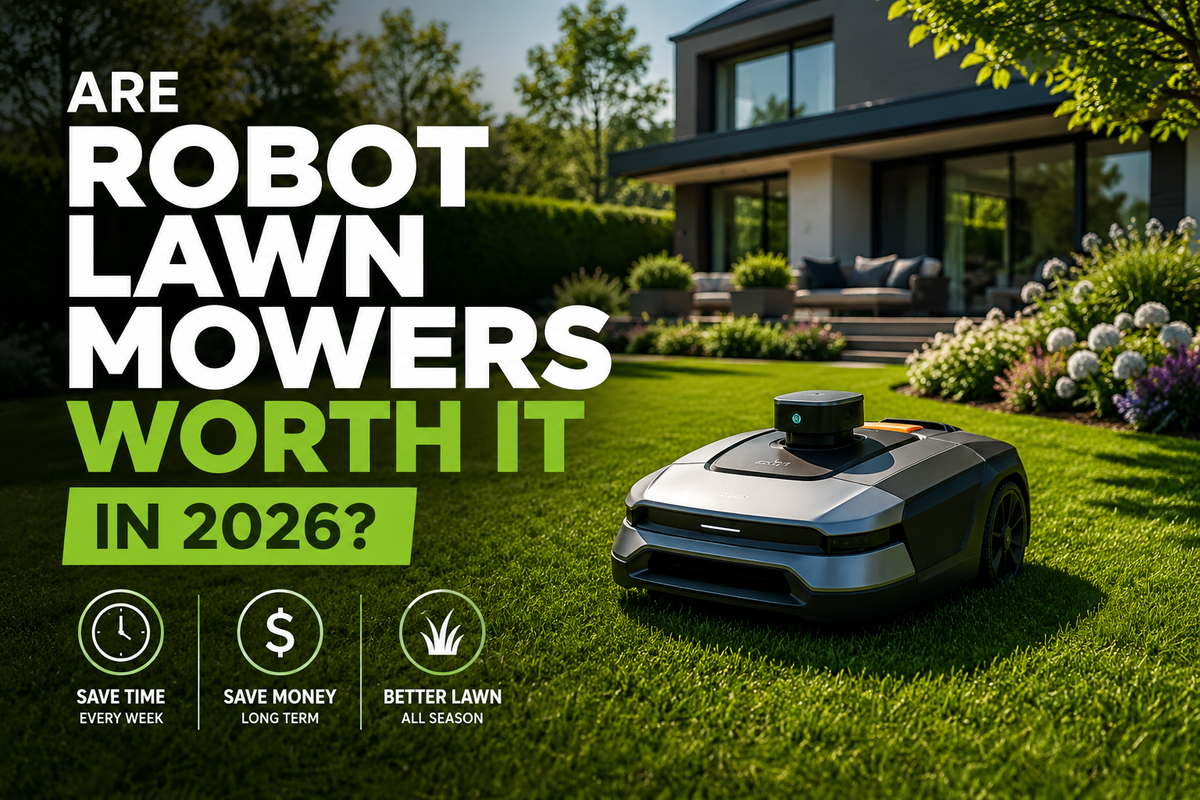
Are Robot Lawn Mowers Worth It in 2026?
Robot lawn mowers are no longer just a futuristic backyard gadget.
In 2026, they are becoming a serious option for homeowners who want to save time, reduce weekly mowing, avoid recurring lawn service bills, and keep their lawn maintained more consistently.
But are robot lawn mowers actually worth it?
For many homeowners, yes. A robot lawn mower can be worth it if your yard is a good fit, you choose the right model, and you understand what robotic mowing can and cannot replace.
The key is choosing the right mower for your lawn size, terrain, slope, grass type, navigation needs, and expectations. A small clean lawn does not need the same mower as a large sloped property with trees, thick grass, and multiple zones.
In this guide, TheRoboZone explains whether robot lawn mowers are worth it in 2026, who should buy one, who should not, what they cost, how they compare to lawn service, and which models make the most sense for different yards.

Quick Answer: Are Robot Lawn Mowers Worth It?
Robot lawn mowers are worth it for many homeowners who want to save time, automate routine mowing, and reduce the long term cost of lawn maintenance.
They are especially worth it if you currently mow your own lawn every week or pay for regular lawn service.
A robot mower is usually most valuable when:
- You want your weekends back
- You pay for weekly or biweekly lawn mowing
- Your lawn is already maintained
- You want more consistent grass height
- Your yard fits the mower’s coverage and slope rating
- You are okay with setup, app control, and occasional maintenance
- You understand that trimming and edging may still be needed
Robot lawn mowers are not worth it for every yard. If your property is extremely overgrown, full of debris, disconnected by stairs, too steep for the mower, or needs full landscaping service every week, a robot mower may not replace everything you need.
The better question is not whether robot lawn mowers are worth it for everyone. The better question is whether the right robot lawn mower is worth it for your yard.
Why Robot Lawn Mowers Are More Worth Considering in 2026
Robot lawn mowers have improved a lot over the last few years.
Older robotic mowers were often limited by boundary wires, smaller coverage areas, basic navigation, weaker traction, and random mowing patterns. Newer models can offer wire free mapping, RTK navigation, vision support, LiDAR, AI cameras, obstacle detection, app based zones, stronger slope handling, and better coverage for larger yards.
That does not mean every robot mower is amazing. It means buyers now have better options for different types of properties.
What Has Improved
- More wire free mower options
- Better app control
- Improved mapping and zone management
- RTK, GPS, EPOS, vision, and LiDAR based navigation
- Stronger traction for slopes and uneven ground
- Better options for large residential yards
- More premium models for difficult properties
If you looked at robot mowers years ago and decided they were not ready, it may be worth looking again in 2026.
Robot Lawn Mower vs Traditional Lawn Mowing
The biggest advantage of a robot lawn mower is time.
Traditional mowing requires you to get the mower out, cut the lawn, trim around edges, clean up, store the mower, and repeat the same process every week or two during mowing season.
A robot lawn mower changes the job from manual labor to automated maintenance.
| Category | Traditional Mowing | Robot Lawn Mower |
|---|---|---|
| Time required | You do the mowing yourself | The mower handles regular mowing automatically |
| Consistency | Depends on your schedule | Can mow more frequently to maintain height |
| Physical effort | High | Low after setup |
| Recurring work | Every mowing cycle | Mostly setup, monitoring, blades, and maintenance |
| Best for | People who enjoy mowing or have simple needs | People who want automation and time savings |
If you enjoy mowing, a robot mower may not feel necessary. If mowing feels like a chore, a robot mower can be one of the most noticeable upgrades you make to your property.
Robot Lawn Mower vs Lawn Service

Robot lawn mowers can also make sense for homeowners who currently pay for lawn service.
Lawn service is convenient, but it is a recurring expense. A robot mower is an upfront investment that can reduce or replace regular mowing visits over time.
That does not mean a robot mower replaces every landscaping task. Lawn service may include trimming, edging, cleanup, fertilization, weed control, mulching, and seasonal work. A robot mower mainly replaces routine mowing.
If you want a deeper breakdown, read our full comparison: Robot lawn mower vs lawn service, which saves more time and money?
Simple Cost Comparison
| Lawn Service Cost Per Visit | 20 Visits Per Season | 30 Visits Per Season | 36 Visits Per Season |
|---|---|---|---|
| $45 | $900 | $1,350 | $1,620 |
| $60 | $1,200 | $1,800 | $2,160 |
| $75 | $1,500 | $2,250 | $2,700 |
| $100 | $2,000 | $3,000 | $3,600 |
For homeowners paying for regular mowing, the math can become attractive fast.
If you are paying $1,500 to $3,000 per season for mowing, a robot mower may start to make financial sense over a few seasons, especially if you plan to stay in the home and your yard is compatible with automation.
Do Robot Lawn Mowers Save Money?
They can.
A robot mower usually saves the most money when it replaces recurring mowing service or reduces how often you need professional lawn help.
The savings are weaker if your lawn is very small, you already mow it yourself with a mower you own, or you still need a lawn company for full property maintenance every week.
A Robot Mower Can Save Money If:
- You pay for mowing every week or every other week
- Your annual mowing bill is high
- Your yard is a good fit for robotic mowing
- You mostly need mowing, not full landscaping service
- You plan to use the mower for multiple seasons
A Robot Mower May Not Save Much If:
- Your lawn is very small
- You already mow quickly and do not mind it
- You need full service landscaping every week
- Your yard needs major prep before automation
- You buy the wrong mower for your property
The biggest mistake is buying based only on price. The mower has to fit the yard. An undersized mower can create more frustration than savings.
Do Robot Lawn Mowers Save Time?

Yes, time savings are one of the strongest reasons to buy a robot lawn mower.
Even if a robot mower does not fully eliminate every lawn task, it can remove the most repetitive part of lawn care. Instead of blocking out time to mow every week, you manage the mower, adjust settings, clean it when needed, and replace blades as part of normal maintenance.
That can be a major lifestyle upgrade.
Robot Mowers Save Time By:
- Automating regular mowing
- Reducing weekend yard work
- Maintaining grass more consistently
- Reducing the need to coordinate mowing service visits
- Letting many homeowners manage mowing from an app
If your goal is to get time back, a robot lawn mower can be worth it even before you calculate the money.
Do Robot Lawn Mowers Cut Well?
A properly matched robot lawn mower can keep a lawn looking clean and consistent.
Most robot mowers are designed for maintenance mowing. That means they work best when they cut smaller amounts of grass more often instead of waiting until the lawn gets tall and cutting it down all at once.
This is different from traditional mowing. A robot mower is not usually meant to rescue a neglected lawn in one pass. It is meant to maintain a lawn that is already in reasonable condition.
Robot Mowers Usually Work Best When:
- The grass is already cut to a manageable height
- The yard is clear of sticks, toys, hoses, and debris
- The mower is sized correctly for the property
- The mowing schedule is set properly
- The blades are replaced when needed
- The lawn does not exceed the mower’s slope or terrain limits
If your lawn is tall, thick, wet, or overgrown, cut it down first before expecting a robot mower to maintain it.
Are Robot Lawn Mowers Worth It for Large Yards?

They can be very worth it for large yards, but only if you choose a mower built for that size and terrain.
Large yards are where the time savings and lawn service savings can be strongest. They are also where choosing the wrong mower can create the most problems.
For large residential lawns, look for stronger coverage, dependable navigation, good traction, appropriate cutting width, and the ability to handle multiple zones.
For many large residential yards, Lymow One Plus is a strong option to compare because it is designed for larger and more complex lawns with a tracked drive system and wire free RTK plus VSLAM navigation.
For acreage and estate style properties, Yarbo is another strong direction because it is built for larger properties and uses RTK GPS, cameras, ultrasonic radar, and smart sensors.
If your property is large, read our guide to the best robot lawn mowers for large yards in 2026.
Are Robot Lawn Mowers Worth It for Hills and Slopes?
Robot lawn mowers can be worth it for hills and slopes, but slope capability matters.
This is not the place to guess. You need to compare the steepest part of your yard against the mower’s slope rating and traction design.
Some mowers are better for clean residential slopes. Others are better for rough terrain, thick grass, or larger properties with more demanding conditions.
For sloped and uneven residential yards, Lymow One Plus is a strong option to compare. For acreage and large sloped properties, Yarbo is worth comparing. For steep or rough areas where direct control matters, Mowrator S1 4WD is different because it is remote controlled rather than fully autonomous.
If your lawn has hills, read our full guide to the best robot lawn mowers for hills, slopes, and uneven yards.
Are Wire Free Robot Lawn Mowers Worth It?
For many buyers in 2026, wire free robot lawn mowers are the most interesting category.
Older robotic mowers often required a boundary wire around the lawn. Wire free models can use virtual boundaries, RTK, GPS, EPOS, vision, LiDAR, cameras, or sensors to map the yard without installing physical perimeter wire.
This can make setup cleaner and more flexible, especially for larger properties or yards with multiple zones.
However, wire free does not mean no setup. The mower still needs proper mapping, signal conditions, charging station placement, app setup, and zone planning.
For a deeper explanation, read robot lawn mowers, boundary wire vs no boundary wire.
Do Robot Lawn Mowers Need WiFi or GPS?
Some do and some do not.
WiFi is usually used for app control, software updates, alerts, schedules, and remote features. GPS, RTK, EPOS, vision, or LiDAR is usually more related to how a wire free mower navigates and maps the yard.
The exact connection requirements depend on the mower.
If your yard has weak WiFi, heavy tree cover, narrow side yards, or poor satellite visibility, you should choose carefully.
For a full breakdown, read do robot lawn mowers need WiFi or GPS to work?
Are Robot Lawn Mowers Safe?
Robot lawn mowers are designed with safety features, but they still require responsible use.
Most modern robotic mowers include lift sensors, tilt sensors, obstacle detection, blade shutoff behavior, and app based controls depending on the model. But no mower should be treated like a toy.
Before mowing, clear the lawn of toys, hoses, rocks, branches, pet waste, and loose objects. Supervise the mower during early use so you understand how it behaves around your yard.
Good Safety Habits
- Keep children and pets away during mowing
- Clear the lawn before running the mower
- Use no go zones where needed
- Follow the manufacturer’s safety instructions
- Inspect the mower and blades regularly
- Do not operate the mower in conditions outside its intended use
A robot mower can be a smart tool, but it still has blades. Treat it with the same respect you would give any mower.
What Are the Downsides of Robot Lawn Mowers?

Robot lawn mowers are worth it for many homeowners, but they are not perfect.
The most common downsides are upfront cost, setup time, yard compatibility, occasional trimming, blade replacement, and learning the app or mapping system.
Common Downsides
- Higher upfront cost than a single lawn service visit
- Setup and mapping can take time
- Some yards need prep work first
- Trimming and edging may still be needed
- Overgrown grass may need to be cut down first
- Tree cover and signal issues can affect some wire free models
- Blades, batteries, and parts need maintenance over time
These downsides do not make robot mowers a bad choice. They just mean the buyer needs realistic expectations.
Who Should Buy a Robot Lawn Mower in 2026?
A robot lawn mower is a strong fit for homeowners who want convenience, consistent mowing, and long term value.
A Robot Mower Is Worth It If:
- You hate mowing
- You want more free time
- You pay for regular lawn mowing
- Your yard is already maintained
- You want a cleaner looking lawn between service days
- Your lawn fits the mower’s coverage, slope, and navigation limits
- You are willing to do some setup and basic maintenance
If this sounds like you, a robot mower is worth seriously considering.
Who Should Not Buy a Robot Lawn Mower?
A robot mower may not be the best choice if your expectations are unrealistic or your yard is not ready for automation.
A Robot Mower May Not Be Worth It If:
- Your yard is extremely overgrown
- You need full landscaping service every week
- Your lawn has major holes, ruts, or drainage issues
- Your mowing areas are disconnected by stairs or curbs
- You expect it to completely eliminate trimming
- You do not want any setup, app use, cleaning, or maintenance
- You choose a mower that is too small for the property
In these cases, lawn service, yard prep, or a remote controlled mower may make more sense.
Best Robot Lawn Mowers To Compare in 2026
The right robot mower depends on your yard. Do not choose only by price or brand name. Choose by property fit.
Best Overall for Large and Complex Residential Yards: Lymow One Plus
The Lymow One Plus is a strong option for homeowners who want a premium robotic mower for a larger, sloped, or more complex residential lawn.
Its tracked drive system, RTK plus VSLAM navigation, and terrain focused design make it a strong fit for buyers who need more than a basic residential robot mower.
Best Fit
- Large residential yards
- Sloped lawns
- Uneven terrain
- Thicker grass
- Homeowners who want a premium wire free mowing system
View Lymow One Plus at TheRoboZone
Best for Acreage and Estate Properties: Yarbo
The Yarbo Robotic Lawn Mower is a strong direction for large properties, acreage, and homeowners who want a rugged outdoor robot platform.
Yarbo is designed for large property mowing and uses RTK GPS, cameras, ultrasonic radar, and smart sensors to support wire free operation.
Best Fit
- Acreage
- Estate style properties
- Large lawns
- Sloped or uneven yards
- Buyers who want outdoor automation beyond basic mowing
Best Established Brand Option: Husqvarna Automower iQ Series
For homeowners who want an established robotic mower brand, the Husqvarna Automower iQ Series is worth comparing.
TheRoboZone offers the Husqvarna Automower 410 iQ, Husqvarna Automower 420 iQ, and Husqvarna Automower 440 iQ.
These models are a good fit for maintained residential lawns where the property matches the mower’s coverage range and signal requirements.
Best Fit
- Clean residential lawns
- Maintained properties
- Moderate slopes
- Buyers who want an established mower brand
- Homeowners comparing 0.5 acre, 1 acre, and 2 acre models
Compare Husqvarna Automower iQ models at TheRoboZone
Where Mammotion Fits
Mammotion is also worth comparing for homeowners shopping modern wire free robot mowers.
TheRoboZone offers Mammotion options including Mammotion LUBA 3 AWD. Mammotion can make sense for buyers who want a modern app based mower platform with LiDAR, RTK, and AI camera support on compatible models.
For larger, rougher, or more demanding yards, compare Mammotion carefully against Lymow, Yarbo, Husqvarna, and Mowrator based on slope, terrain, coverage, navigation, and expectations.
View Mammotion robot lawn mowers at TheRoboZone
Best Remote Controlled Option for Difficult Terrain: Mowrator S1 4WD
The Mowrator S1 4WD is not a fully autonomous robot mower. It is a remote controlled mower.
That makes it a different type of solution for homeowners who want direct control on steep, rough, thick, or difficult mowing areas.
Best Fit
- Steep slopes
- Rough terrain
- Overgrown sections
- Drainage areas
- Places where full autonomy may not be practical
View Mowrator S1 4WD at TheRoboZone
Best for Smaller or Simpler Lawns
Not every homeowner needs a large premium robot mower.
For smaller or cleaner residential lawns, compact wire free models like TerraMow, MOVA, Sunseeker, Mammotion, or the right Husqvarna model may be worth comparing depending on lawn size, slope, trees, and navigation needs.
The important thing is to avoid overbuying or underbuying. A simple lawn may not need the biggest system. A complex lawn should not be paired with a basic mower that cannot handle the job.
Shop robot lawn mowers at TheRoboZone
How To Tell If a Robot Mower Is Worth It for Your Yard
Before buying, ask these questions.
| Question | Why It Matters |
|---|---|
| How much lawn do I actually mow? | The mower must be sized for the mowable area, not just total lot size |
| How steep is my yard? | Slope rating and traction are critical |
| Is my lawn smooth or uneven? | Rough terrain may require a stronger mower |
| Do I have trees or weak signal areas? | Navigation type matters for wire free mowers |
| Do I have multiple zones? | Zone management and travel paths matter |
| Do I expect it to replace trimming? | Most owners still need occasional trimming |
| How much do I spend on mowing now? | This helps determine long term value |
If you are not sure whether a robot mower will work in your yard, read our full guide: Will a robot lawn mower work in my yard?
Final Verdict: Are Robot Lawn Mowers Worth It in 2026?

Yes, robot lawn mowers are worth it in 2026 for many homeowners.
They are most worth it if you want to save time, reduce manual mowing, lower recurring lawn service costs, and keep your lawn maintained more consistently.
They are especially valuable for homeowners with larger yards, busy schedules, recurring mowing bills, or properties that are a good fit for automation.
They are not magic. They do not replace every lawn care task. You may still need trimming, edging, cleanup, fertilization, weed control, and occasional manual attention.
But for routine mowing, the right robot mower can be a major upgrade.
For large and complex residential yards, start by comparing Lymow One Plus.
For acreage and estate properties, compare Yarbo.
For maintained residential lawns and an established mower brand, compare Husqvarna Automower iQ models.
For modern wire free options, Mammotion is also worth reviewing.
For steep, rough, or direct control mowing, compare Mowrator S1 4WD.
The best robot mower is not simply the most expensive one. It is the one that fits your lawn size, slope, terrain, navigation needs, and expectations.
If you are not sure which mower makes sense, contact TheRoboZone before buying. Our team can help compare your yard, slope, coverage needs, terrain, and current mowing costs so you choose the right robotic mower the first time.
FAQ
Are robot lawn mowers worth it?
Yes, robot lawn mowers are worth it for many homeowners who want to save time, reduce manual mowing, and automate routine lawn maintenance. They are most worth it when the mower is properly matched to the yard.
Do robot lawn mowers save money?
They can save money if they replace or reduce regular lawn service costs. The savings are strongest for homeowners who currently pay for weekly or biweekly mowing.
Do robot lawn mowers replace lawn service?
They can replace routine mowing in many yards, but they do not replace every landscaping task. Trimming, edging, cleanup, fertilization, and seasonal work may still be needed.
Are robot lawn mowers good for large yards?
Yes, if you choose the right model. Large yards need stronger coverage, good navigation, and the right traction. Lymow One Plus and Yarbo are strong options to compare for larger properties.
Are robot lawn mowers good for hills?
Some are. Slope capability varies by model, so always compare the mower’s slope rating and traction design to your actual yard.
Do robot lawn mowers work without boundary wires?
Many newer models do. Wire free robot mowers can use RTK, GPS, EPOS, vision, LiDAR, cameras, sensors, or app based mapping to create virtual boundaries.
Will I still need to trim if I buy a robot mower?
Usually, yes. A robot mower can handle the main mowing area, but edges near fences, walls, trees, curbs, and landscaping may still need occasional trimming.
Can a robot mower cut tall grass?
Some models handle thicker grass better than others, but robot mowers are usually best for maintenance mowing. If the grass is very tall, cut it down first before starting regular robotic mowing.
What is the biggest downside of a robot mower?
The biggest downsides are upfront cost, setup, yard compatibility, occasional trimming, and maintenance. Choosing the wrong mower for the yard is the biggest mistake.
Should I call before buying a robot lawn mower?
Yes, especially if your yard has hills, trees, multiple zones, rough terrain, thick grass, weak signal areas, or unusual layout issues. TheRoboZone can help match the mower to your property.